
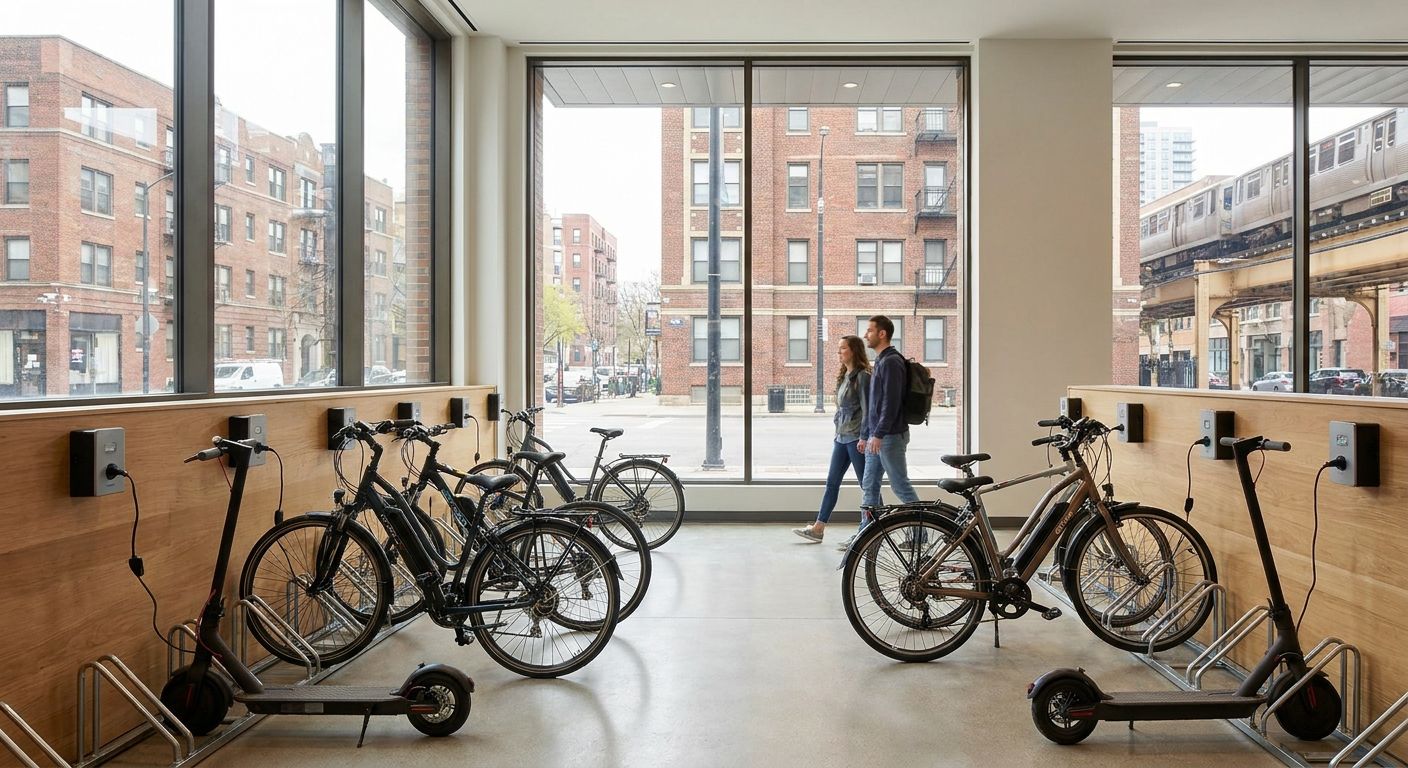
E-bike and scooter renters shopping for Chicago apartments need buildings built around secured storage, wide entry points, and charging access, not just a nice floor plan. Fulton Market's warehouse-turned-residential streets favor two-wheeled commuters, but not every building was designed with a 65-pound e-bike or a folding scooter in mind. The difference between a workable setup and a daily hassle usually comes down to three things: where the bike lives, how it gets there, and whether the lease even allows a lithium battery in the unit.
Stead 220, the 308-unit community at 220 N. Ada Street in Fulton Market, sits inside that calculation. Studios through two-bedroom homes here put renters within a short ride of the Kennedy Expressway bike lanes and the Fulton Market restaurant corridor, and the building's approach to bike storage is one of the first things an e-bike or scooter owner should ask about before touring.
- Apartments for e-bike and scooter storage in Chicago need secured storage, wide entries, and a written lithium battery policy, not just a bike rack.
- Stead 220 in Fulton Market pairs studio-to-two-bedroom homes with dedicated bike storage and freight-capable access for moving gear in.
- Confirm elevator width and unit entry clearance before leasing; a 28-inch e-bike handlebar span won't fit every hallway turn.
- In-unit charging of lithium batteries is a fire-code concern in most Chicago buildings in 2026 - ask before you assume it's allowed.
- Street-level lock-up is the weakest option for e-bike security; a dedicated storage room or locker beats a rack every time.
Why this matters for e-bike and scooter renters
Fulton Market was built for freight, not foot traffic, which is exactly what makes it workable for cargo bikes, step-through e-bikes, and standing scooters - wide sidewalks, protected lanes on nearby streets, and short blocks to the West Loop and Loop. But the neighborhood's older industrial stock and newer high-rises handle two-wheeled gear differently. Some buildings still treat an e-bike like a piece of furniture you carry through the lobby; others have a room for it.
The stakes are higher than they look. Lithium-ion batteries are the reason more property managers in 2026 write explicit charging policies into their lease riders - a swollen or damaged battery charging unattended in a studio closet is a real liability, not a hypothetical one. Renters who skip this question find out the hard way, usually after the lease is signed.
Update your search criteria before you tour
Most apartment hunters filter by bedrooms and price. E-bike and scooter renters need a second filter layer.
- Ask whether the building has a dedicated bike or micromobility storage room, not just an outdoor rack
- Confirm whether e-bikes and scooters are allowed in freight or passenger elevators
- Ask for the building's written policy on charging lithium batteries inside units or common areas
- Check whether storage requires a separate fee or is included with the lease
- Ask about ground-floor or side-entry access that avoids the main lobby entirely
Measure your unit's entry points and elevator dimensions
A cargo e-bike or a wide-frame step-through often won't clear a standard 32-inch interior door on the diagonal, and freight elevators vary more than passenger cars do.
- Measure handlebar width - most e-bikes run 24 to 30 inches
- Check door swing clearance in the unit's entry hallway, not just the doorway itself
- Ask the leasing office for freight elevator interior dimensions if the building lists one
- Confirm whether the building has freight elevators for moving large items, since the same access that gets a couch upstairs gets a cargo bike upstairs
- Walk the actual path from curb to unit during your tour, not just the amenity floor
Locate secured storage before you sign
The manual, no-cost version of this step is simple: ask to see the storage room, not just hear about it.
- Request a photo or walkthrough of the bike storage area during the tour
- Ask whether storage is keyed, badge-access, or open to all residents
- Check whether e-scooters and mopeds are permitted in the same room as bikes
- Ask if there's a waitlist or capacity limit for the space
- Confirm whether storage is climate-controlled, which matters for battery longevity
Buildings that treat this as an afterthought usually don't have a good answer ready. Buildings that have thought it through, like Stead 220's approach with dedicated bike storage for cyclists in Fulton Market, tend to mention it before you ask.
Plan your charging setup
This is where renters get stuck the most, because charging policy varies building to building and isn't always spelled out in the listing.
- Ask directly: is in-unit charging of e-bike or scooter batteries permitted
- If not permitted in-unit, ask whether the storage room has outlets
- Check whether the building requires UL-certified chargers or battery specs
- Ask about EV charging infrastructure in the garage, since some buildings extend outlet access there for micromobility too - Stead 220 lists EV charging stations as part of its parking amenities
- Confirm whether charging outside your unit means leaving the device unattended for hours
Check the commute and street network around the building
An apartment with great storage but a bad ride to work still fails the daily test.
- Map the protected bike lanes nearest the building, not just the ones on the marketing page
- Check whether Divvy or scooter-share docking stations sit within a five-minute walk
- Confirm the ride distance to your actual office, not just "downtown"
- Ask about winter maintenance on nearby lanes, since Chicago plows prioritize car lanes first
Renters who want to skip car ownership entirely should also read how to live car-free in a Fulton Market apartment, since the same infrastructure that supports e-bikes supports a car-free lease.
Book a tour focused on gear, not just square footage
The fastest way to get real answers is to ask the leasing team gear-specific questions on the tour itself, before you fall for a rooftop pool and forget to check the bike room.
- Bring your bike or scooter's exact dimensions written down
- Ask to see the storage room in person, not a rendering
- Ask what happens if the storage room fills up
- Confirm the charging policy in writing, not verbally
Tour Stead 220's storage setup
See the bike storage and building access firsthand before you sign.
Comparing storage options for e-bike and scooter renters
| Option | Best for | Key limitation |
|---|---|---|
| Dedicated bike/micromobility storage room | Renters who own one or two e-bikes or scooters and want secured, indoor access | Space and capacity limits vary by building |
| In-unit storage | Renters with a single folding scooter or compact e-bike | Charging policy and hallway clearance issues are common |
| Street-level bike rack | Renters without a car-free commute plan or a spare bike | Weakest security option; not weather-protected |
| Third-party off-site storage | Renters with multiple bikes or seasonal storage needs | Adds a separate trip and cost outside the lease |
Verdict: a dedicated, badge-access storage room beats every other option on this list for security and convenience - Stead 220's Fulton Market building is built around that model rather than treating micromobility as an afterthought.
Common mistakes e-bike and scooter renters make
- Assuming the listing photos show the whole storage setup. A rack in a hallway photo isn't the same as a secured room - ask for specifics.
- Skipping the battery policy question until after signing. Some Chicago leases in 2026 explicitly restrict in-unit lithium charging; find out before move-in day, not after.
- Not measuring the bike before touring. A cargo e-bike that's 30 inches wide won't clear every unit door on the turn from the hallway.
- Ignoring winter storage needs. A rack that works in July becomes unusable once Chicago's freeze-thaw cycle starts in November.
- Choosing a building for the rooftop instead of the route. A great amenity deck doesn't matter if the nearest protected bike lane is eight blocks away.
FAQ
What should I ask about before renting an apartment with an e-bike in Chicago?
Ask whether the building has dedicated, secured bike or micromobility storage, what the lithium battery charging policy is, and whether freight or passenger elevators allow bikes. Confirm these in writing before signing, since verbal answers from a leasing tour don't always match the actual lease terms.
Are e-bikes allowed in Chicago apartment buildings in 2026?
Most Chicago apartment buildings allow e-bikes, but policies on where they can be stored and charged vary by property. Some restrict in-unit charging of lithium batteries for fire-safety reasons, so confirm the specific building's rules rather than assuming a blanket policy.
Does Stead 220 have bike storage for e-bikes and scooters?
Stead 220's Fulton Market building includes dedicated bike storage as part of its resident amenities, alongside a rooftop pool and fitness center. Renters should confirm current storage capacity and charging access directly with the leasing team during a tour.
What's the best neighborhood in Chicago for e-bike commuters?
Fulton Market and the West Loop rank among the strongest options for e-bike commuters in 2026 because of protected bike lanes, short blocks, and proximity to downtown offices. The area's industrial-to-residential conversion also means many buildings were designed with wider entries and freight access.
Can I charge my e-bike battery inside my Chicago apartment?
It depends on the building's lease terms - some permit in-unit charging while others restrict it to designated storage areas for fire-safety reasons. Get the charging policy in writing before you move in rather than assuming it's allowed.
How wide does a hallway need to be for an e-bike?
Most e-bike handlebars measure 24 to 30 inches wide, so hallway and doorway clearance needs to account for turning radius, not just the doorway width itself. Measure your specific bike and walk the actual path from curb to unit during a tour.
Is street parking safe for an e-bike in Chicago?
Street-level racks are the weakest security option for e-bikes because of their higher resale value compared to standard bikes, and they offer no weather protection. A secured indoor storage room is the safer choice for renters who own an e-bike or electric scooter.
One last thing
The detail most renters skip is asking whether storage capacity is fixed or first-come, first-served - a building can advertise "bike storage" and still run out of space by the time you move in during peak leasing months. Ask for the current occupancy of the storage room, not just its existence, before you sign anything in 2026.