
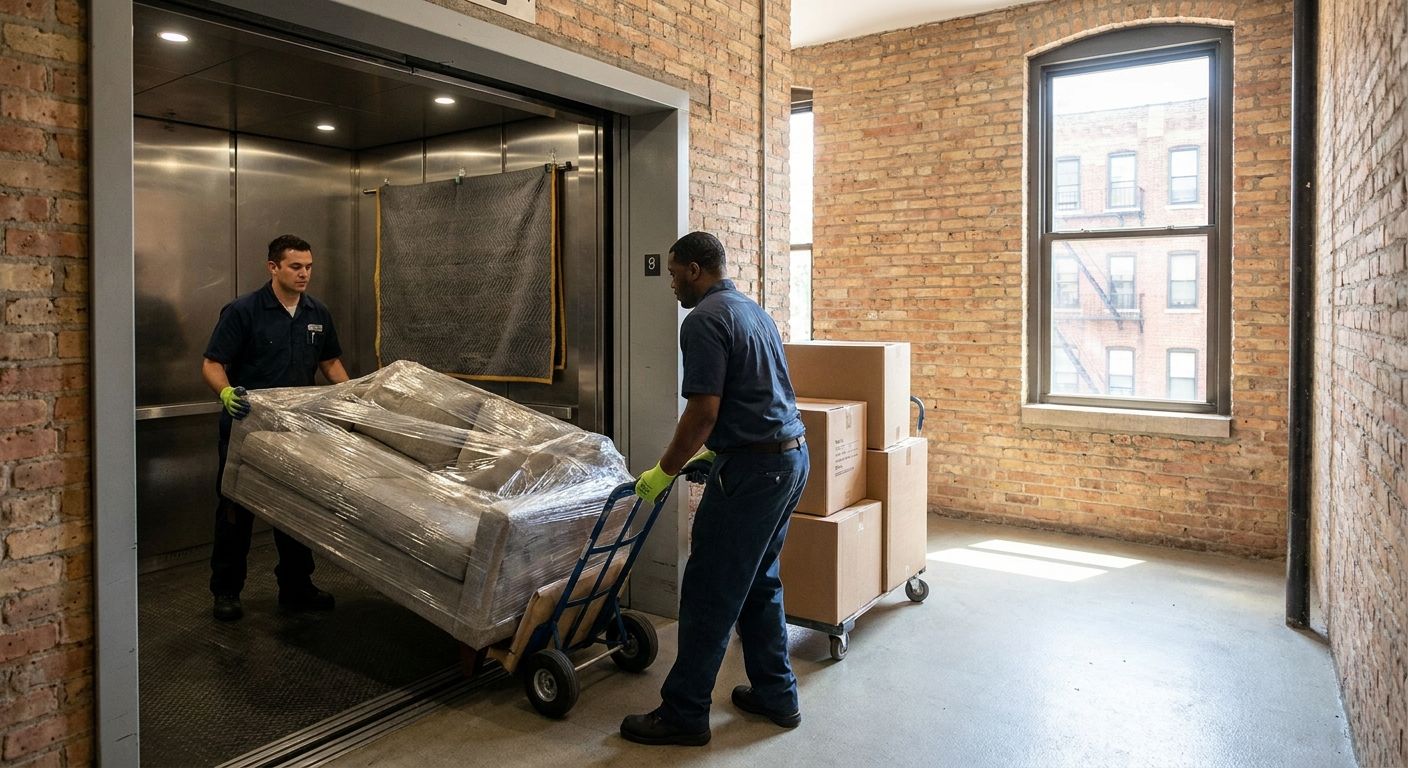
Renters moving oversized furniture, king bed frames, sectionals, upright pianos, or floor-to-ceiling bookcases, need to confirm freight elevator access before they sign a lease in Chicago, not after the moving truck is double-parked outside a high-rise in 2026. Passenger elevators in most Chicago apartment buildings are built for people and grocery bags, not a 9-foot sectional or a solid oak dresser, and the wrong building turns move-in day into a scheduling and damage-liability problem.
- Apartments with freight elevators in Chicago protect passenger cabs, hallway trim, and doorframes from oversized furniture damage.
- Fulton Market high-rises often require move-in reservations 48 to 72 hours ahead of the actual move.
- Measure your largest piece against elevator door width and cab height before you sign, not during move-in week.
- Ask specifically about loading dock hours and mover insurance requirements when touring a building like Stead 220.
Why freight elevator access matters for large-furniture movers
A standard passenger elevator cab in a mid-rise or high-rise building typically has a door opening around 36 inches wide, sometimes narrower in older Chicago vintage buildings. A king-size bed frame, a 7-foot sofa, or a upright piano routinely exceeds that clearance once you account for turning angles in a hallway or lobby.
Freight elevators solve this because they're built wider and taller, often 42 to 48 inches at the door, with reinforced walls and higher weight capacity than a passenger cab. Buildings that have one usually pair it with a dedicated loading dock, a service entrance separate from the residential lobby, and a booking system so movers don't collide with residents heading to work.
This matters more in Fulton Market and West Loop specifically. The neighborhood mixes converted industrial buildings with new high-rise construction, and elevator specs vary building to building even on the same block. A renter who assumes every high-rise has freight capacity is the renter who gets a same-day call from the property manager saying the couch doesn't fit.
Confirm elevator specs before you tour
Don't wait for the leasing tour to ask about elevator dimensions. Call ahead or check the listing.
- Ask for the freight or service elevator's door width and cab depth in inches
- Ask whether the building has a dedicated freight elevator or a single passenger car used for both
- Ask if there's a weight limit on the freight car
- Confirm whether the loading dock has a ramp or requires lifting furniture up a curb
- Request this in writing or via email so you have it if a dispute comes up later
Measure your furniture against the building's numbers
A freight elevator that's 42 inches wide doesn't help if your furniture doesn't fit at an angle through a narrower hallway or unit doorway.
- Measure the widest dimension of every large piece: sofas, sectionals, dressers, mattresses
- Measure diagonally, since most furniture goes through doorways tilted, not flat
- Check the unit's own interior doorway widths, not just the building elevator
- Note ceiling height in stairwells if the elevator is ever out of service
- Flag anything over 84 inches long as a piece that needs professional movers, not friends with a truck
Book your move-in window early
Buildings with freight elevators almost always require a reservation, and popular move-in days fill up fast during peak leasing season.
- Reserve the freight elevator 48 to 72 hours before your move date at minimum
- Ask if there's a maximum time window, some buildings cap freight reservations at 2 to 4 hours
- Confirm whether weekend slots exist or if moves are restricted to weekdays
- Find out if a certificate of insurance from your moving company is required to book
- Get the reservation confirmation in writing, ideally by email
One renter's move can go smoothly or badly depending entirely on whether this step happened two weeks out or two days out. Book the freight elevator the same week you sign the lease, not the week you move.
Hire movers who know freight-elevator buildings
Not every moving company is used to working within a booked elevator window and a loading dock schedule.
- Ask movers directly if they've worked in high-rise or Fulton Market buildings before
- Confirm they carry a certificate of insurance most Chicago property managers require
- Ask how they pad elevator walls and hallway corners during the move
- Get a written estimate that accounts for the building's freight elevator time limit
- Avoid movers who balk at providing insurance documentation, that's a red flag for damage claims
Protect common areas during the move
Even with a freight elevator, hallways, lobby floors, and elevator interiors take damage from moving day traffic.
- Ask the property manager if they provide floor and wall padding, or if you need to bring your own
- Walk the move-in route in advance and note tight corners or low doorframes
- Confirm who's liable for damage: renter, mover, or building, before move-in day
- Keep the freight elevator doors from being propped open longer than the reserved window
Tour Stead 220 before you book movers
Ask about elevator access and move-in logistics on your walkthrough.
Compare building types for large-furniture moves
Not every Chicago building type handles oversized furniture the same way. Here's how the common options stack up.
| Option | Best for | Key limitation |
|---|---|---|
| High-rise with dedicated freight elevator | Renters with sectionals, pianos, king beds | Requires advance booking, limited time slots |
| Doorman building with reserved passenger car | Smaller furniture, mid-size moves | Passenger cab width caps what fits |
| Vintage walk-up conversion | Studio and one-bedroom moves | No elevator at all in many cases, stairs only |
| New-construction high-rise with loading dock | Full-service moves, corporate relocations | Dock hours may be restricted on weekends |
When you tour a 300-plus-unit community like Stead 220 in Fulton Market, ask where it falls on this table before you assume anything based on the building's age or size. A large unit count doesn't automatically mean freight capacity, and a smaller boutique building sometimes has better loading logistics than a bigger one.
Common mistakes large-furniture movers make
- Assuming size equals capability. A 308-unit high-rise isn't automatically better equipped than a 50-unit building, ask about the actual elevator specs rather than guessing from unit count.
- Skipping the diagonal measurement. Furniture that's 40 inches wide on paper often needs 50-plus inches of clearance to angle through a hallway turn.
- Booking movers before booking the elevator. If the freight car isn't reserved, your movers show up and wait, and some companies charge for that idle time.
- Ignoring the certificate of insurance requirement. Many Chicago property managers won't release the freight elevator without one on file, and this can delay a move by days if it's requested last minute.
- Forgetting the return trip. Old furniture removal needs the same elevator window as the new furniture delivery; double-book if you're doing both on the same day.
FAQ
How do I find apartments with freight elevators in Chicago?
Call the leasing office directly and ask for the freight or service elevator's door width, cab depth, and weight limit before touring. Listings rarely specify this detail, so it takes a direct question.
Do all Fulton Market high-rises have freight elevators?
No. Fulton Market mixes converted industrial buildings and new high-rise construction, and freight capacity varies by building even on the same block in 2026.
How wide does a freight elevator need to be for a king bed frame?
Most king bed frame pieces need at least 42 inches of clearance to move at an angle through a doorway or elevator opening. Confirm the building's exact cab dimensions before you commit to a lease.
How far in advance should I book a freight elevator for moving day?
Reserve it 48 to 72 hours ahead at minimum, since popular move-in days during peak leasing season fill fast. Some buildings require a certificate of insurance from your movers before confirming the booking.
What happens if a building doesn't have a freight elevator?
Large furniture either doesn't fit through the passenger cab or has to go up the stairwell, which adds time, risk of damage, and often extra mover fees. Confirm this before signing if you own oversized pieces.
Is a loading dock the same as a freight elevator?
No, a loading dock is where the moving truck parks and unloads, while a freight elevator moves furniture from the dock or lobby up to the unit. Buildings with strong move-in logistics usually have both.
Can I move a piano into a high-rise apartment without a freight elevator?
It's possible but riskier and usually requires specialized piano movers and building sign-off, since an upright piano exceeds most passenger elevator weight and width limits. Ask the property manager directly before scheduling.
One last thing
The detail most renters skip is asking about the return trip: moving out old furniture usually needs the same freight elevator reservation as moving in new furniture, and property managers in 2026 are seeing more same-day double-bookings than in prior years because renters plan for delivery but forget removal. Book both legs of the move in one reservation call, not two separate ones.