Skis, snowboards, boots, and poles fit into a Chicago apartment without swallowing your closet if you store them vertically, off the floor, and by how often you actually use them. Coat closets and under-bed space handle most gear; a private storage unit covers the overflow once winter equipment starts competing with everyday storage.
- Vertical ski and snowboard racks keep coat closet floors clear in a one-bedroom Chicago apartment.
- Boots, helmets and poles fit under the bed or on closet-door racks instead of stacking on shelves.
- A private storage unit or storage cage covers overflow once gear spans skiing, snowboarding and skating in one household.
- Fulton Market renters weigh winter gear against studio-to-two-bedroom layouts, so seasonal rotation matters more than raw square footage.
Why this matters
Chicago's ski and snowboard season runs roughly five months, November through March, which means gear sits idle for the other seven. A studio or one-bedroom apartment doesn't have a mudroom or a garage to absorb that dead weight, so the storage plan has to work in reverse: gear needs to disappear completely in the off-season and come out fast when the first snow hits.
Renters who find apartments with private storage units solve this before it becomes a problem. Everyone else needs a closet system that does double duty.
How to store winter sports gear in a Chicago apartment
- Sort gear by frequency. Skis and snowboards you use weekly stay accessible; ice skates and sleds you touch twice a season go to the back or into a bin.
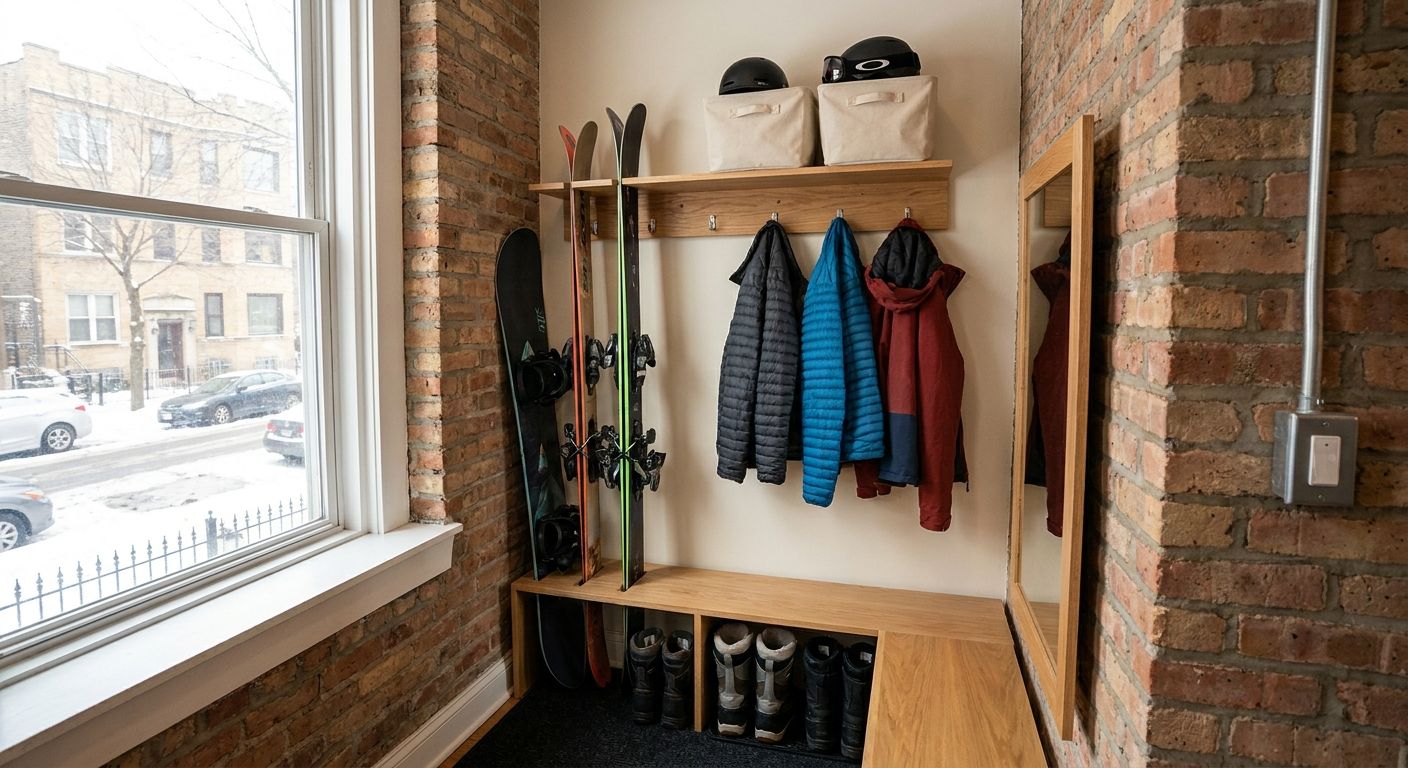
- Rack skis and snowboards vertically. A wall-mounted or floor rack holds two to six pairs standing up, which uses a fraction of the floor space that leaning gear against a wall does.
- Bin boots and helmets under the bed. A shallow under-bed container keeps boots dry and out of the closet's main shelf space.
- Bag base layers and gloves flat. Vacuum bags or thin duffels compress soft gear so it slides onto a shelf instead of taking up a drawer.
- Move the overflow off-site. Once gear from two or more sports competes for the same closet, a storage unit or cage becomes cheaper than losing usable apartment space.
This order matters because it forces a decision on volume before you buy bins. Renters who skip step one usually end up with three half-full totes instead of one organized system.
Skis and snowboards: vertical storage over floor space
A pair of skis or a snowboard leaned against a wall takes up roughly the same footprint as a small end table, and it falls over. A slim vertical rack mounted inside a coat closet door or against the closet's back wall solves both problems at once — it holds the board upright, off the floor, and out of the way of coats and shoes.
For renters in a two-bedroom layout, a second closet or a corner of a guest room can hold a small rack for a household with more than one skier. Vertical storage is the single highest-impact change you can make to a small closet.
Boots, helmets and poles: under-bed and door storage
Boots are the bulkiest single item after the skis themselves, and they're wet more often than any other piece of gear. An under-bed bin with a lid keeps boots contained and lets them air out without soaking a closet floor.
Helmets and poles go on an over-the-door organizer or a high shelf — they're light, so weight isn't the issue, it's just clutter. Renters furnishing a smaller unit for the first time often build this system alongside their general move-in setup; the same principles that apply when you furnish a studio apartment in Chicago apply directly to gear storage — vertical first, floor space last.
Bulky gear overflow: when to rent a storage unit
Once winter gear covers skiing, snowboarding, and ice skating for more than one person, most apartment closets run out of room regardless of how well they're organized. That's the point where a private storage unit or a building storage cage pays for itself in reclaimed living space rather than in convenience.
Moving that volume of gear in and out twice a year is easier in a building with wide elevator access — a factor worth checking alongside apartments with freight elevators for moving large furniture, since the same access that handles a couch handles a season's worth of ski bags.
Why storage strategy varies by apartment
Not every unit needs the same setup. The right approach depends on:
- Closet count and depth — a unit with two closets splits gear from clothing; a unit with one closet forces a bin-and-under-bed system
- Number of household members who ski or ride — one skier needs a rack; a family of four needs a rack plus bins plus a storage unit
- Unit size — a studio has less margin for error than a two-bedroom, so vertical storage matters more
- Building storage options — a building with a storage room or cage removes the need to cram everything into the unit itself
- How often gear rotates — weekly skiers need front-of-closet access; occasional sledders can box gear and forget it until December
Where do Chicago apartment renters store skis in winter?
Most renters store skis in a coat closet on a vertical rack, since floor leaning wastes space and risks damage to bindings. Renters without a second closet often shift boots and helmets to under-bed bins to free up hanging space for the skis themselves.
Do apartment buildings offer storage rooms for renters?
Some buildings do, and it's worth confirming during a tour rather than assuming. A private storage unit removes the guesswork entirely and is the most reliable fix once seasonal gear starts crowding a coat closet in 2026.
How do you store a bike and ski gear in the same closet?
A bike and ski gear share a closet by splitting vertical zones — the bike hangs from a wall hook or ceiling mount, while skis and a snowboard use a floor rack below it. Renters juggling both year-round often look at buildings with dedicated bike storage for cyclists in Fulton Market to keep the two systems from competing for the same square footage.
Tour a Fulton Market layout today
See studio-to-two-bedroom floor plans at Stead 220 before winter gear season starts.
Stead 220, a 308-unit apartment community at 220 N. Ada Street in Fulton Market, leases studios through two-bedroom homes, and layout choice is the first variable in any winter gear plan — a two-bedroom simply has more closet volume to work with than a studio. Renters comparing this apartment community against others in the neighborhood should walk closets with actual gear dimensions in mind, not just square footage on a floor plan.
FAQ
What's the best way to store skis in a small apartment?
A wall-mounted or floor vertical rack inside a coat closet is the best way to store skis in a small apartment, since it keeps them upright and off the floor. Leaning skis against a wall wastes closet floor space and risks bent edges or scratched bindings.
Do I need a storage unit for winter sports gear?
You need a storage unit for winter sports gear once it covers more than one sport or one person's equipment, since a single closet rarely holds skis, boots, and a snowboard together. A single skier with one closet can usually skip it.
How do you keep ski boots from smelling in an apartment?
Ski boots stay odor-free in an apartment when they air out fully before storage, ideally in a ventilated under-bed bin rather than a sealed closet. Removing liners and letting them dry separately for a day cuts moisture buildup significantly.
Is under-bed storage good for winter gear?
Under-bed storage works well for boots, helmets, and gloves because it's out of sight and doesn't compete with closet shelving. Skis and snowboards are too long for most under-bed bins and need vertical closet space instead.
Can you store a snowboard in a closet?
Yes, a snowboard fits in most coat closets when mounted on a slim vertical rack against the back wall or door. Storing it flat on the closet floor wastes space that could hold boots and bins.
How much closet space does winter gear need in a Chicago apartment?
Winter gear for one skier typically needs a narrow vertical slot for the board plus one shelf or bin for boots, helmet, and poles. A household with multiple winter sports usually outgrows a single closet and needs a storage unit.
Where should sleds and ice skates go in an apartment?
Sleds and ice skates go on a high closet shelf or in a labeled bin since they're used less often than skis or a snowboard during the five-month Chicago season. Keeping them separate from daily-use gear avoids digging through a full closet every time you need skis.
One last thing
The gear that actually causes clutter problems in 2026 isn't the skis — it's the wet boots and damp base layers that get shoved back into a closet before they're dry. Solve moisture first and the space problem gets a lot smaller on its own.