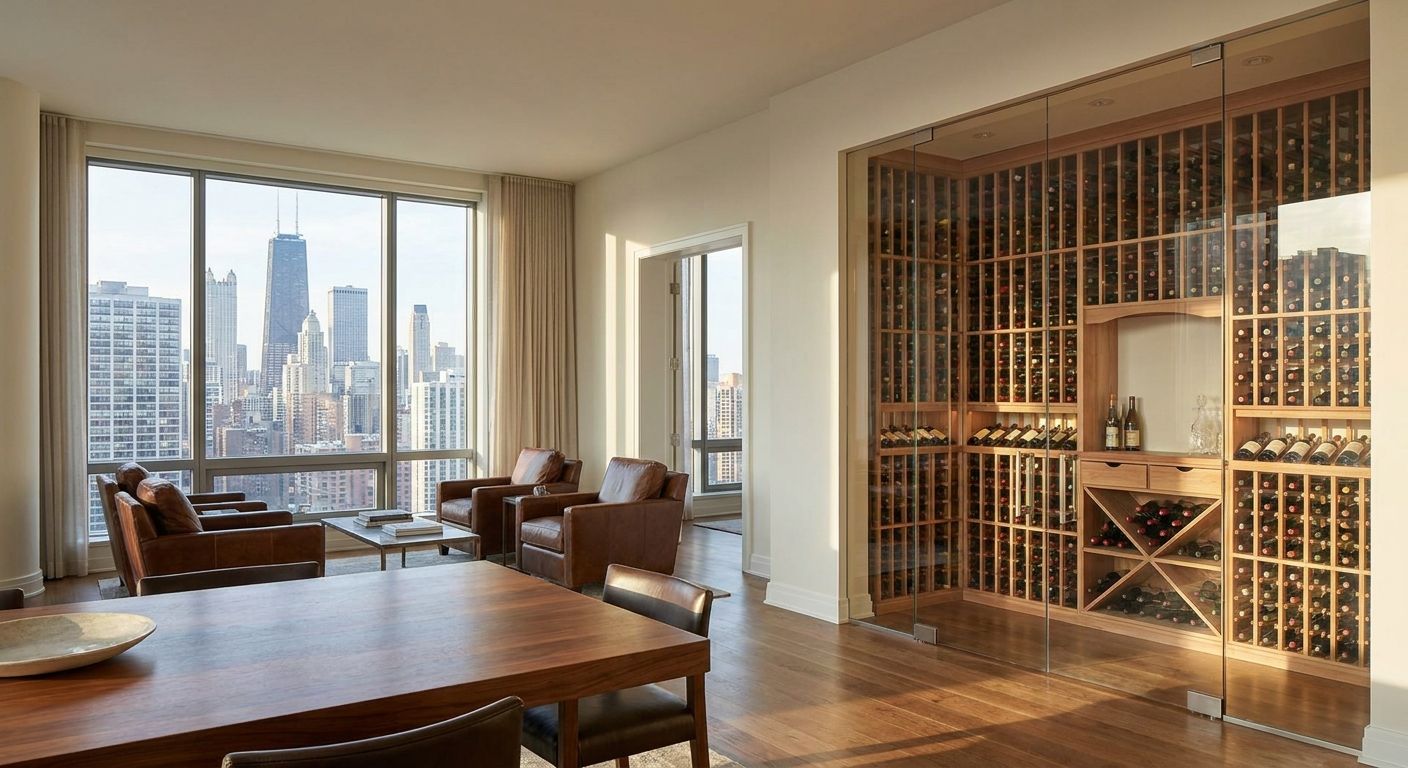
Private wine storage rooms are rare in Chicago's rental market, and most listings that use the phrase actually mean a wine fridge nook or a shared amenity closet with a temperature dial. This guide separates the buildings and building types that genuinely support long-term bottle storage in 2026 from the ones that just borrowed the term for a listing photo.
- Apartments chicago private wine storage options concentrate in new-construction Fulton Market high-rises built after 2015 -- confirm climate control before you sign.
- In-unit wine fridges outperform shared wine rooms for reliability in 2026 leases. Buy the workaround over the marketing term.
- Vintage Gold Coast buildings sometimes have real cellar space from pre-1930s construction, but co-op approval slows access. Hold.
- Stead220, a 308-unit community at 220 N. Ada Street in Fulton Market, lists rooftop pool and fitness center amenities -- ask leasing directly about wine storage add-ons.
Why this matters
A renter searching apartments chicago private wine storage in 2026 is usually trying to solve one of two problems: protecting an existing collection during a move, or wanting the amenity as a signal of building quality. Those are different searches with different answers.
Collectors need actual temperature and humidity control -- roughly 55degF and 70% humidity is the standard cellar target used by wine storage professionals. Renters chasing prestige just need a building that treats storage as infrastructure, not decor. Confusing the two leads to disappointment when the "wine room" turns out to be a shelf next to the package lockers.
How this list was ranked
The ranking below sorts Chicago's rental stock by building type and construction era, since that predicts wine storage odds better than any single listing claim. Newer Fulton Market and West Loop high-rises get credit for engineered mechanical systems. Vintage Gold Coast stock gets credit for existing basement cellar space. Marketing language that promises a room without describing controls gets marked down regardless of neighborhood.
The ranked list
1. Fulton Market new-construction high-rises -- the safest bet
Fulton Market's build-out accelerated after 2015, when the neighborhood shifted from meatpacking warehouses to tech-anchored high-rises near employers like Google and Mondelez International. Buildings from this wave were engineered with modern HVAC zoning, which is the actual prerequisite for any wine storage claim to hold up.
Stead220 sits in this tier: a 308-unit community at 220 N. Ada Street with a rooftop pool and fitness center already built into the amenity program. If you're comparing new-construction Fulton Market apartments, ask leasing directly whether wine storage is offered as a paid add-on rather than assuming it from the building class. Consider.
2. West Loop boutique loft conversions -- the design-forward option
Converted commercial buildings in West Loop keep exposed brick and masonry walls that hold temperature more evenly than floor-to-ceiling glass towers. That thermal mass is a real advantage for anyone storing bottles long-term, even without a dedicated room.
The tradeoff is scale -- boutique conversions rarely have the unit count to justify a shared wine room, so storage tends to live inside the unit. Consider, especially if you also want the loft aesthetic.
3. Vintage Gold Coast pre-1930s buildings -- the long shot with real cellars
Some of Chicago's oldest Gold Coast buildings were constructed with basement storage rooms originally meant for coal, later repurposed by co-op boards into shared wine lockers. These are the buildings most likely to have an actual cellar rather than a rebranded closet.
Access usually requires board approval and a waiting list, which slows down a move-in timeline. Hold unless you have time to wait through the approval process.
4. South Loop new towers -- the value tier
South Loop's post-2010 towers compete on price more than amenity depth, so wine storage loses out to package rooms and fitness centers when developers allocate square footage. It's not that the buildings are lower quality -- the amenity mix is just prioritized differently.
If wine storage is a must-have rather than a nice-to-have, this tier is a Skip. If it's one of several amenities on a longer list, it's still worth touring.
5. In-unit wine fridges -- the practical substitute
Undercounter wine fridges built into kitchen islands are now standard in a meaningful share of 2020s-era luxury units, and they solve most of what renters actually need from wine storage: consistent temperature for a rotating collection of a dozen to two dozen bottles. They don't require board approval, a waiting list, or a shared-space reservation system.
For renters comparing private storage unit apartments against a shared wine room, the in-unit fridge is the lower-friction answer. Buy this as the default plan unless you specifically need cellar-scale capacity.
6. "Wine room" as marketing language without controls -- the trap
Some buildings label a shelf in the resident lounge or a corner of the package room as wine storage without any temperature or humidity control attached. This does nothing for bottle preservation and exists purely as a listing bullet point.
A wine room without humidity control is a closet with a label. Skip any listing that can't answer a direct question about degrees and humidity percentage.
“A wine room without humidity control is a closet with a label.”
Comparison table
| Building type | Storage format | Climate control odds | 2026 verdict |
|---|---|---|---|
| Fulton Market new-construction | Shared room or add-on | High -- modern HVAC | Consider |
| West Loop loft conversions | In-unit, masonry-assisted | Moderate | Consider |
| Gold Coast pre-1930s | Shared cellar | High, if approved | Hold |
| South Loop new towers | Rarely offered | Low priority | Skip if it's a must-have |
| In-unit wine fridge (any building) | In-unit appliance | High -- self-controlled | Buy |
| "Wine room" as marketing term only | Shelf, uncontrolled | None | Skip |
Tour Stead220 in Fulton Market
See the rooftop pool, fitness center, and unit finishes in person.
Where to secure it
- Ask for the spec, not the pitch. Get the actual temperature and humidity range in writing before treating a wine room as confirmed -- verbal promises from a leasing tour don't survive a lease dispute.
- Check the fee structure before you sign. Wine storage, when offered, is usually a paid add-on separate from base rent, and that line item belongs in the lease amendment, not a side conversation.
- Confirm insurance coverage for stored bottles. Renters insurance often excludes high-value collections unless you add a rider, which matters more than the room itself if you're storing anything expensive.
Stead220 apartments in Fulton Market keep this kind of detail-level comparison simple -- oak hardwood floors, TechnoGym equipment in the fitness center, and Italian wardrobes in the closets are the kind of material specifics worth asking about for any amenity claim, wine storage included. Shaped around how people actually live, not how a listing photographs.
FAQ
What's the best neighborhood in Chicago for apartments with private wine storage?
Fulton Market has the strongest odds in 2026 because most of its high-rises were engineered after 2015 with modern HVAC systems capable of supporting climate-controlled storage. Vintage Gold Coast buildings sometimes have real cellar space too, but access usually requires co-op board approval.
Is a private wine room the same as a wine fridge?
No -- a wine room is a shared or dedicated space with building-level climate control, while a wine fridge is an in-unit appliance you control yourself. For most renters, the in-unit fridge is the more reliable option in 2026.
How much does apartment wine storage cost in Chicago?
Cost varies by building and is typically billed as a monthly add-on fee separate from base rent. Ask leasing for the exact line item before signing rather than assuming it's bundled into amenity fees.
Do luxury high-rises in Fulton Market include wine storage as standard?
Not automatically. Fulton Market buildings are more likely than older stock to have the mechanical systems that support it, but wine storage is usually a paid add-on rather than a standard included amenity.
Is climate control included in shared wine lockers?
It depends entirely on the building. A shared wine locker without stated temperature and humidity specs is not providing real climate control, regardless of what the listing calls it.
Can I add a wine fridge to a studio apartment?
Yes, undercounter wine fridges fit into most studio and one-bedroom kitchen layouts in 2026 construction and don't require building approval the way a shared wine room would.
How do I confirm a building's wine storage is climate-controlled?
Ask leasing for the specific temperature and humidity range in writing before touring. A building that can't answer with numbers is describing a shelf, not a wine room.
Are older buildings better for wine cellars than new construction?
Some pre-1930s Gold Coast buildings have genuine basement cellar space repurposed from coal storage, which new construction doesn't replicate. New construction wins instead on consistent mechanical systems and faster move-in access.
One last thing
The detail that separates a real wine storage amenity from a marketing line isn't square footage -- it's whether the building can hand you a written temperature and humidity spec on request. If the leasing office answers with a number instead of an adjective, the room is real.