Chicago apartment fees rarely show up as one number. A building might advertise a $50 application fee, then add a $200 amenity fee, a $250 admin fee, and a deposit-alternative charge before you ever sign — and none of it shows up until you're mid-application.
This guide breaks down every fee category you'll hit while touring Fulton Market and West Loop buildings, including Stead 220, so you can compare apples to apples before you commit an application fee that's rarely refundable.
- Chicago apartment application fees comparison should separate one-time fees from recurring monthly charges before you compare buildings.
- Application fees typically run $25-$75 per applicant and are nonrefundable in most Chicago leases in 2026.
- Amenity fees and admin fees often add $150-$400 to move-in cost beyond the advertised rent.
- Get every fee itemized in writing before applying — verbal quotes change once you're at the leasing table.
Why this matters
A $50 application fee looks cheap next to a $99 one. But if the $50 building tacks on a $300 nonrefundable amenity fee and the $99 building doesn't, you paid more at the cheaper door.
Most renters compare the headline fee and skip the line items underneath it. That's how a studio that looked like the better deal on paper ends up costing $400 more to move into than a comparable unit. Chicago doesn't cap application fees the way some states cap theirs, so the range across buildings is wide enough to matter.
What you'll need
- The fee sheet or FAQ page from every building you're seriously considering
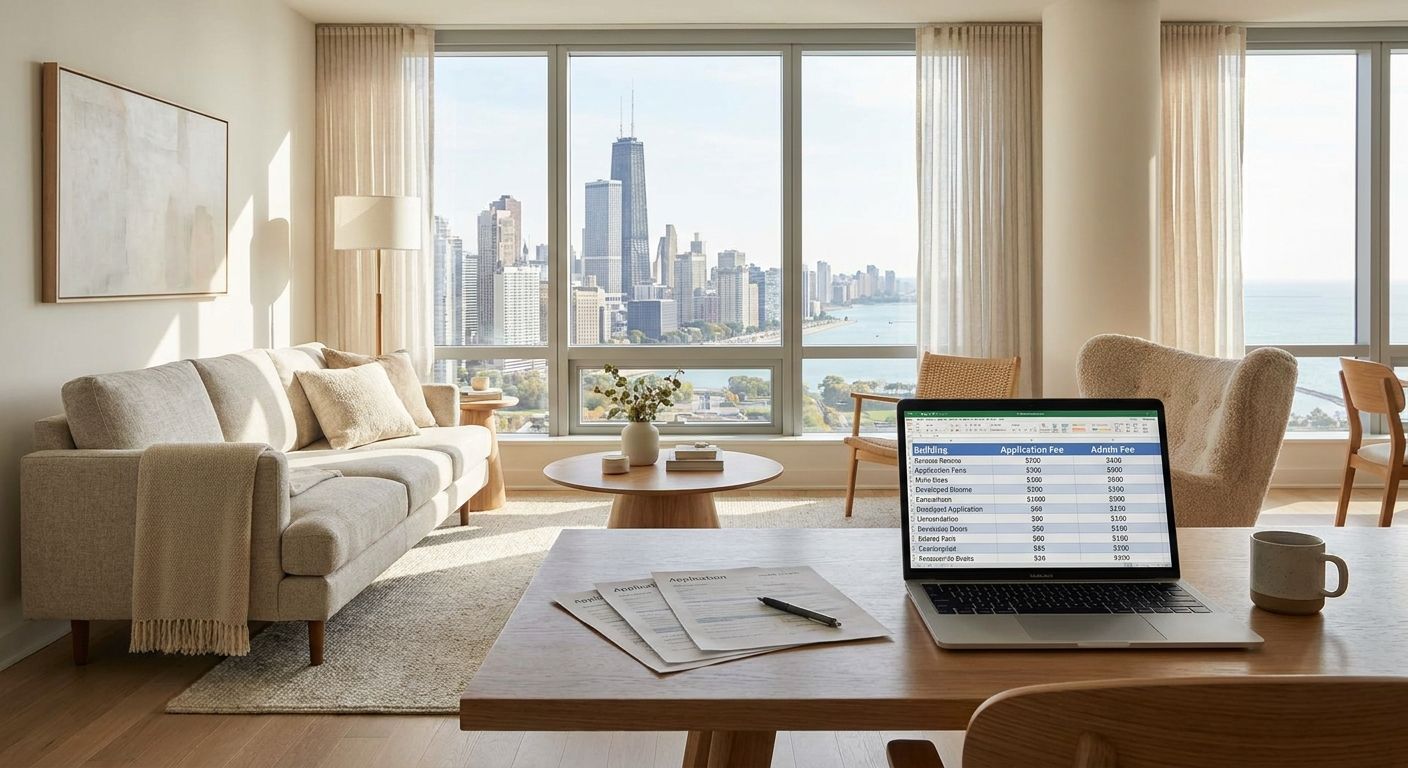
- A notepad or spreadsheet — one row per fee, one column per building
- 30-45 minutes before you submit any application
- A clear answer to "refundable or not" for every line item
- The unit's actual monthly rent, not the "starting at" number
The steps
1. Pull every fee line item before you apply
Ask the leasing office directly: "Can you send me a full list of every fee I'll be charged from application through move-in?" Do this by email so you have it in writing.
Most Chicago buildings won't volunteer the full list on a tour — you have to ask for it. Expect application fees, admin fees, amenity fees, and sometimes a technology or package-locker fee bundled separately from rent.
Common mistake: accepting a verbal quote from the leasing agent instead of getting the itemized list emailed. Verbal numbers shift once you're filling out paperwork.
2. Separate one-time fees from recurring fees
Sort every line item into two buckets: things you pay once (application fee, admin fee, security deposit) and things you pay every month (amenity fee, parking, pet rent). Mixing these two categories is the single biggest reason people misjudge true cost.
A $35/month amenity fee sounds small next to a $500 one-time admin fee, but over a 12-month lease that amenity fee costs $420 — nearly as much as the admin fee itself.
3. Calculate your real move-in cost, not the advertised rent
Add application fee plus admin fee plus security deposit (or deposit-alternative premium) plus first month's rent plus any prorated amount. That total is what actually leaves your account before you get keys.
Renters comparing buildings for the first time in Chicago often use this exact math to catch buildings that quote low rent but recover it through move-in fees — a pattern that shows up often enough in apartments for first-time renters in Chicago searches that it's worth budgeting for before you tour.
Expected outcome: a single number — total cash due at signing — that you can put next to every building on your shortlist.
4. Compare the application fee against what it actually covers
A legitimate application fee covers a credit check and background check per applicant, typically in the $25-$75 range as of 2026. If a building charges $150 or more per applicant, ask what's included beyond standard screening.
Some buildings charge the fee per applicant even for co-applicants on the same lease. If you're applying with a roommate or partner, confirm whether the fee doubles.
5. Ask which fees are refundable if you're denied or withdraw
Application fees are almost never refunded once screening runs — that's standard across Chicago rentals in 2026. Admin fees and amenity fees are a different story and vary building to building.
Get the refund policy in writing before you pay anything. If a leasing office won't put it in an email, treat that as a red flag on the fee itself.
6. Weigh amenity fees against amenities you'll actually use
A $250 one-time amenity fee that unlocks a rooftop pool, a fitness center, and package lockers is a different value proposition than the same fee at a building with a single shared laundry room. Price the fee against what you'll realistically use monthly, not what's listed on the amenity page.
This matters most for renters relocating for work who won't have time to explore every building perk in the first few months — a common scenario among corporate relocators in Fulton Market weighing multiple offers at once.
Get a full fee breakdown before you apply
See exact costs for Stead 220 studios through two-bedrooms.
7. Run the total against your lease term, not just move-in day
Multiply any recurring fee by 12 (or your lease length) and add it to your one-time total. This is the number that actually determines which building costs less over the life of your lease — not the number printed on the listing.
Common mistake: comparing two buildings only on move-in cost and ignoring that one charges a $40/month amenity fee the other doesn't. Over a 12-month lease, that's a $480 gap the move-in comparison missed entirely.
Troubleshooting
The fee sheet doesn't match what you were quoted on the tour. Ask for the discrepancy in writing before you pay. Leasing agents sometimes quote promotional rates that expire or don't apply to your specific unit.
You were charged the application fee but never heard back. Chicago has no standard turnaround requirement for application decisions, so follow up in writing after 5-7 business days and ask for a status update.
The amenity fee is mandatory even if you won't use the amenities. Most buildings bundle amenity access into the lease structure rather than making it optional — confirm this before applying, not after you've paid the fee.
You're being asked to pay the application fee again for a lease renewal. Renewals typically don't require a new application fee since you're already an existing resident. Push back if this comes up.
Two buildings quote different application fees for the same applicant profile. Ask each building what the fee actually covers — some run a full background check plus credit check, others run credit only at a lower price point.
The security deposit and the application fee got combined into one number on a quote. These are two separate charges with different purposes and different refund rules. Ask the leasing office to break them apart in writing.
Tools and resources
- A simple spreadsheet with rows for application fee, admin fee, amenity fee, deposit, and monthly recurring fees
- Written fee disclosures from every building, requested by email
- The Chicago Residential Landlord and Tenant Ordinance summary, for general deposit-handling rules
- A calculator for total move-in cost, not just advertised rent
Buildings differ widely in how they structure amenity access. Rooftop pool apartments built for summer entertaining tend to bundle that access into a single one-time fee rather than monthly billing — worth confirming before you assume a recurring charge.
What to do next
Once you've compared fee sheets side by side, narrow your list to buildings where the total move-in cost and monthly recurring fees both make sense for your budget. If you're weighing a studio against a one-bedroom for cost efficiency, the deeper comparison for studio apartments for remote workers in Fulton Market covers how fee structures shift between unit types in 2026.
FAQ
What is a typical apartment application fee in Chicago in 2026?
Chicago apartment application fees typically run $25-$75 per applicant in 2026, covering a credit check and background check. Fees above $100 usually indicate additional screening or a bundled admin charge.
Are Chicago apartment application fees refundable?
No, application fees are almost never refunded once screening has run, even if you're denied or withdraw. Ask the leasing office in writing before applying if refund terms differ.
What's the difference between an application fee and an admin fee?
An application fee covers background and credit screening for one applicant, while an admin fee is a separate one-time charge that covers lease processing and setup. Buildings often charge both, so ask for each line item separately.
Do amenity fees count toward my monthly rent?
Amenity fees are usually billed separately from rent, either as a one-time move-in charge or a recurring monthly line item. Confirm which structure applies before signing, since the two affect your total lease cost differently.
Is it normal to pay an application fee for each roommate?
Yes, most Chicago buildings charge the application fee per adult applicant on the lease, including roommates and co-signers. Ask upfront whether the fee doubles for multiple applicants.
How do I compare application fees across multiple Chicago buildings?
List every fee line item per building, separate one-time from recurring charges, and total the real move-in cost rather than comparing headline fees alone. This chicago apartment application fees comparison method catches hidden costs a simple fee comparison misses.
Can a landlord charge an application fee and then deny the application without explanation?
Yes, application fees cover the cost of running screening regardless of outcome, and Chicago doesn't require landlords to provide a denial reason. The fee is for the service of screening, not a guarantee of approval.
Do I need to pay an application fee again when renewing my lease?
No, renewals typically skip the application fee since you're already an approved resident with an existing lease history. If a building tries to charge it anyway, ask why.
One last thing
The fee that trips up the most renters isn't the application fee — it's the one-time amenity fee that gets quoted verbally on a tour and never shows up in writing until the lease is in front of you. Ask for every fee itemized by email before you submit an application, and treat any leasing office that won't do that as a signal to keep looking.