Smart thermostat apartments in Fulton Market Chicago let renters control heating and cooling from an app instead of a wall dial, which matters more in a city where January lows and August highs both hit hard. The segment searching for this isn't chasing a gadget — they're hybrid workers and design-conscious renters who want a home that adjusts to an irregular schedule without a wasted energy bill sitting on the counter.
- Smart thermostat apartments in Fulton Market Chicago give renters app-based climate control instead of a fixed wall dial.
- Nest, Ecobee, and Honeywell Home cover most building-installed systems in Chicago high-rises as of 2026.
- Stead220 renters should confirm in-unit thermostat control and zone coverage on a tour before signing.
- Corner units and west-facing floors need more scheduling flexibility because of direct afternoon sun.
- Ask about WiFi coverage in mechanical closets — a smart thermostat with no signal is just a dumb one.
Why smart thermostat apartments matter in Fulton Market
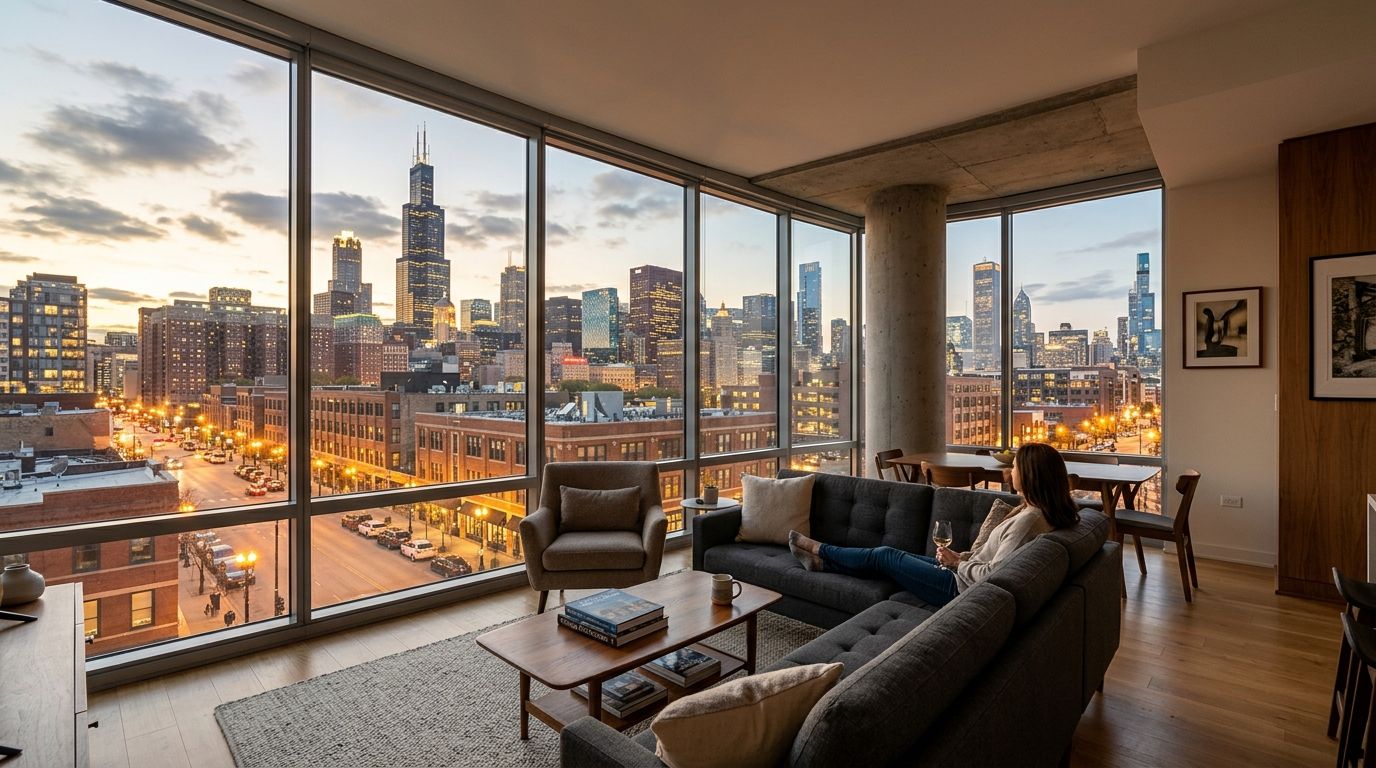
Chicago swings from single-digit wind chills in February to 90-degree stretches in July, and a Fulton Market high-rise holds heat differently floor to floor. A unit on a high corner with floor-to-ceiling glass heats up faster in direct sun than an interior unit two floors down — a fixed thermostat schedule doesn't account for that difference, but an app-controlled one does.
Hybrid workers are the segment driving this search: someone home three days a week and out four wants the apartment cooling down before they walk in, not after. A smart thermostat apartment matters most to renters who don't keep a 9-to-5 schedule, because a programmable-only unit assumes a routine that a hybrid week doesn't have.
Renters comparing amenities across Stead220 and other Fulton Market buildings in 2026 are also comparing total monthly cost, not just rent — a thermostat that learns a schedule and avoids running heat or air conditioning against an empty apartment is a real line-item difference over a 12-month lease.
How to evaluate smart thermostat apartments in Fulton Market
Check what thermostat hardware is already installed
Before touring, ask the leasing office directly what thermostat model is in the unit — some Fulton Market buildings retrofitted older stock with app-connected units, others built app control in from day one.
- Ask if the thermostat is wall-mounted or app-only
- Confirm whether the app requires a building-specific login or a consumer account (Nest app, Ecobee app)
- Ask if the thermostat controls one zone or multiple
- Check if the building charges separately for a smart thermostat upgrade
- Confirm the thermostat works over the unit's existing WiFi, not a hardwired-only connection
Test the thermostat during your tour, not after you sign
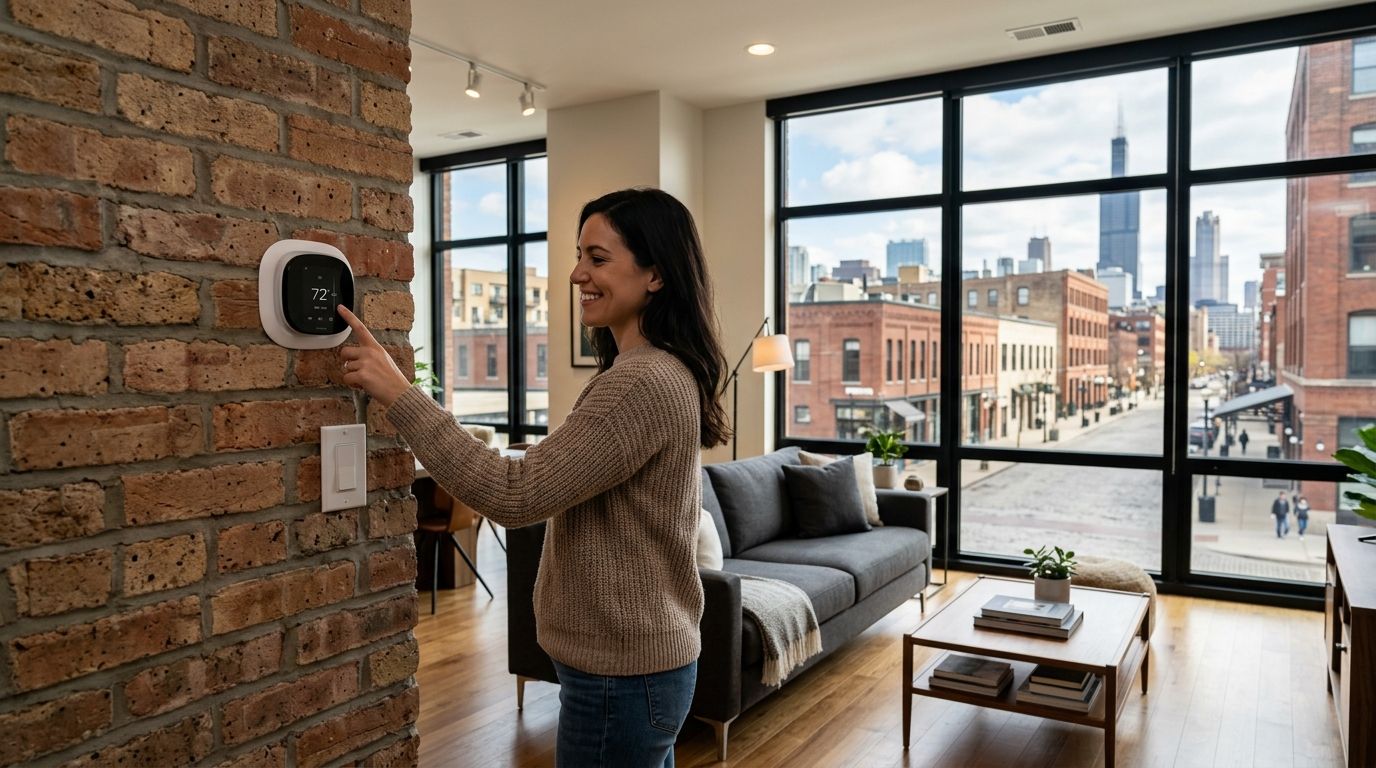
Don't take the leasing agent's word for it — open the app on the unit's display or your phone during the walkthrough and change the temperature by a few degrees to confirm it responds.
- Watch how long the system takes to respond to a manual change
- Check the app's scheduling screen for weekday versus weekend settings
- Ask if the thermostat reports energy use history
- Confirm the app works on both iOS and Android before you assume it does
- Note whether the thermostat display works without the app if your phone dies
Compare zone control across floor plans
A studio has one thermostat covering one room; a two-bedroom may need two zones to keep a bedroom cool while a living room with west-facing glass runs warmer. This is where touring Stead220, a 308-unit Fulton Market community with studios through two-bedroom homes, gives you a direct comparison — ask the leasing team how thermostat zones map to each floor plan before you commit to a layout.
- Ask if each bedroom gets independent control or shares one zone with the living area
- Confirm which zone the thermostat sensor physically sits in
- Ask how the building handles temperature complaints in shared-zone layouts
- Check whether a den or flex room counts as its own zone
- Ask if corner units get a different HVAC configuration than interior units
Ask about winter heat retention specifically
A smart thermostat helps less if the building's heat retention is poor — floor-to-ceiling windows look sharp but lose heat faster than smaller openings, and Chicago winters expose that gap fast. Renters preparing to prepare a high-rise apartment for Chicago winter should factor thermostat scheduling into that plan from the start, not after the first cold snap.
- Ask if window seals were updated recently
- Confirm if the building has a maintenance line for heating issues after hours
- Ask how thermostat scheduling interacts with building-wide heat during shoulder seasons
- Check if the unit has supplemental heat sources beyond the central system
Combine thermostat control with other smart home features
A smart thermostat rarely stands alone — renters shopping this segment in 2026 are usually also comparing keyless entry, smart locks, and app-based building access as part of one connected experience. Reviewing apartments with keyless entry and smart locks alongside thermostat control gives a fuller picture of how connected a building actually is versus how connected it markets itself as.
- Ask if the same app controls locks, thermostat, and lighting or if they're separate systems
- Confirm if guest access codes work independently of climate settings
- Ask if the building offers any app-based maintenance request system
- Check battery backup on smart locks paired with smart thermostats during outages
Confirm maintenance and support terms before signing
A smart thermostat that breaks in February and takes two weeks to fix is worse than no smart thermostat at all. Ask directly who handles thermostat repairs — in-house maintenance or a third-party smart home vendor — and how fast that response typically runs.
- Ask what the average maintenance response time is for HVAC issues
- Confirm if thermostat malfunctions are covered under the lease or billed separately
- Ask if there's a backup manual override if the app or WiFi goes down
- Check whether the lease specifies smart home equipment terms at all
Book a Fulton Market tour
Ask the leasing team to walk you through in-unit climate controls.
Comparing thermostat options across Fulton Market apartments
| Option | Best For | Control Method | Key Limitation |
|---|---|---|---|
| Nest Learning Thermostat | Renters who want automated schedule learning | Nest app, voice assistant integration | Requires stable WiFi; learning period takes several weeks |
| Ecobee | Multi-room units needing sensor-based zone balancing | Ecobee app with remote sensors | Remote sensors add setup steps at move-in |
| Honeywell Home | Renters who want a simpler app without heavy automation | Honeywell Home app | Fewer smart-home integrations than Nest or Ecobee |
| Building-standard programmable thermostat | Renters prioritizing simplicity over app control | Manual wall programming only | No remote access, no scheduling from a phone |
Verdict: renters who split time between home and office should prioritize app-based remote control over a programmable-only thermostat — a fixed schedule can't adjust for a Tuesday spent downtown instead of at the desk.
Common mistakes renters make hunting for smart thermostat apartments
- Assuming every Fulton Market high-rise has app control — many buildings still run programmable-only systems despite marketing language that implies otherwise.
- Skipping the in-person app test — a listing photo of a thermostat display doesn't confirm the app actually connects or responds quickly.
- Ignoring zone layout in larger floor plans — a two-bedroom with one thermostat zone means one roommate controls both rooms' temperature.
- Not asking about WiFi dead zones near mechanical closets — a thermostat with no signal reverts to manual control, defeating the entire feature.
- Overlooking maintenance response time — a smart thermostat is only as good as how fast it gets fixed when it stops responding.
FAQ
What is a smart thermostat apartment in Fulton Market?
A smart thermostat apartment lets renters control heating and cooling through a phone app instead of a fixed wall dial. In Fulton Market, this usually means a Nest, Ecobee, or Honeywell Home system tied to the unit's own zone.
Do all Fulton Market apartments have smart thermostats in 2026?
No. Many buildings still use programmable-only wall thermostats without app control. Confirm the exact hardware with the leasing office before assuming a listing includes smart climate control.
Is Nest better than Ecobee for a Chicago high-rise apartment?
Nest suits renters who want automated schedule learning with minimal setup, while Ecobee's remote sensors work better in multi-room units with uneven sun exposure. Neither is universally better — it depends on floor plan and zone count.
How much does a smart thermostat save on energy in a Chicago apartment?
Savings depend on building HVAC efficiency and how often the unit sits empty, which varies by lease and floor plan. Ask the building directly for any documented energy data rather than relying on general estimates.
Can renters install their own smart thermostat in a Fulton Market apartment?
Most leases require landlord approval before installing hardware that alters existing wiring. Ask the leasing team whether tenant-installed smart thermostats are permitted or whether the building-installed system is the only option.
What happens if the smart thermostat loses WiFi connection?
Most smart thermostats fall back to manual, on-device control when WiFi drops. Confirm this fallback works during your tour rather than assuming it after move-in.
Do smart thermostats control multiple rooms in a two-bedroom apartment?
It depends on the building's HVAC zoning, not the thermostat brand alone. Some two-bedroom units share one zone across both bedrooms while others split into independent zones.
Are smart thermostats worth it for renters who work from home part-time?
Yes, for renters with an irregular schedule, app-based scheduling adjusts for days spent out of the apartment in a way a fixed programmable thermostat cannot.
One last thing
The detail most renters skip: ask whether the thermostat's remote sensor (if the system uses one, like Ecobee) sits in the room you actually spend the most time in, not just wherever the installer put it by default — a sensor in an empty guest bedroom reads the wrong temperature all day. That single placement question, asked on a tour in 2026, tells you more about real comfort than any spec sheet.