
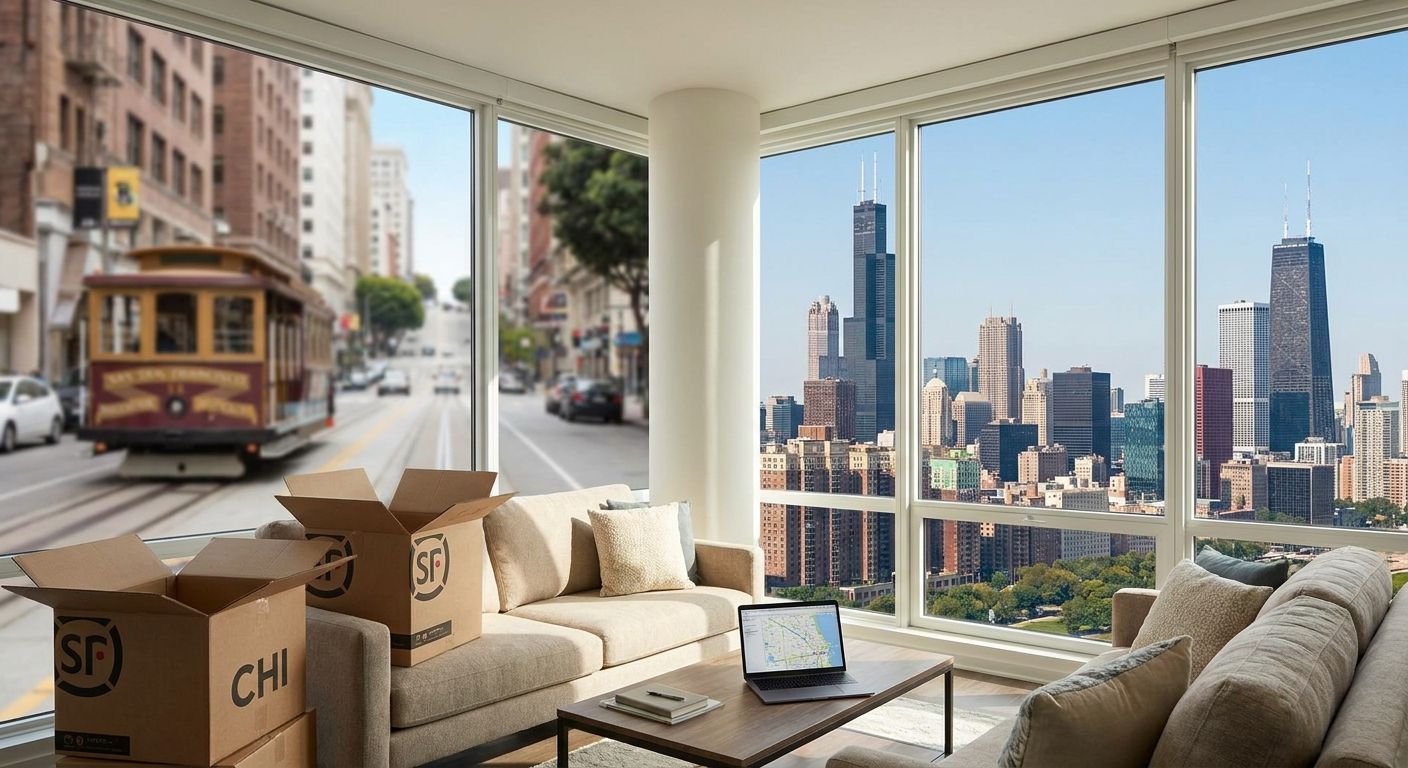
Renters moving from San Francisco to Chicago trade a scarce, expensive rental market for more square footage, predictable move-in timelines, and a downtown where design-forward buildings like Stead 220 stand in for the tech-campus perks they left behind. The math changes here: Illinois has no earthquake retrofits baked into rent, but it does have four real seasons, and that reshapes what "amenities" and "commute" actually mean once you unpack the moving truck.
- Apartments for renters moving from San Francisco to Chicago in 2026 favor Fulton Market and West Loop for tech and finance transplants.
- Chicago rent buys more square footage than San Francisco at every unit size, per widely cited national rent comparisons.
- Out-of-state income verification and lease timing matter more here than in SF's month-to-month-heavy market.
- Stead 220 replaces a Bay Area gym membership and rooftop scene with TechnoGym equipment and a rooftop pool on-site.
- Winter prep, not earthquake prep, is the logistics gap most SF renters miss before their first Chicago January.
Why this matters for renters relocating from San Francisco to Chicago
San Francisco and Chicago are both dense, walkable, transit-served cities, which is exactly why the differences trip people up. San Francisco renters are used to fierce competition for small units and landlords who move fast on decisions. Chicago's leasing calendar runs on more predictable seasonal cycles, and buildings in neighborhoods like Fulton Market and West Loop compete on finish quality and amenities rather than just square footage scarcity.
The bigger adjustment is climate and lifestyle, not price. San Francisco's fog and 55-to-65-degree year-round range doesn't prepare anyone for a Chicago winter that regularly drops below freezing for weeks. Renters who plan for that shift, rather than discovering it in January 2026, land in buildings that actually support how they'll live for twelve months, not just the move-in month.
How to plan a move from San Francisco to Chicago
Recalibrate your rent expectations by unit type, not by city average
City-wide rent averages hide the real story. San Francisco has consistently ranked among the most expensive rental markets in the country, and Chicago has consistently ranked well below it, but the gap varies sharply by unit type and neighborhood.
- Compare studio-to-one-bedroom rent, not citywide medians, since that's where the biggest relative gap shows up
- Price two-bedroom units separately if you're considering a roommate split
- Factor in that Chicago units run larger on average square footage than comparable SF units
- Check whether heat is included in rent, since Chicago buildings vary on this and it affects your real monthly cost
- Ask about move-in specials or waived deposits, which show up more often in Chicago's leasing cycles than in SF's tighter market
Pick a neighborhood that matches your San Francisco habits
Matching neighborhood character beats matching a map pin. Renters who loved SOMA's warehouse-to-office energy tend to land well in Fulton Market. Renters who wanted Pacific Heights quiet tend to look further north or in Lincoln Park instead.
- Fulton Market for renters who liked SF's Mission/SOMA mix of restaurants, galleries, and tech offices
- West Loop for a slightly more residential, still walkable version of the same energy
- River North for nightlife density closer to what the Marina or North Beach offered
- Wicker Park for renters who lived in the Mission for the independent retail and music scene
- Check walk score and transit score directly instead of assuming Chicago neighborhoods map cleanly onto SF ones
Line up out-of-state income and credit verification early
California landlords are used to high-earning renters with unconventional pay structures, like RSUs or SF tech equity. Chicago leasing offices ask for standard documentation, and international or interstate credit history doesn't always transfer cleanly.
- Pull your credit report before applying, since a California-based score can take longer to process through some Illinois screening systems
- Have two to three recent pay stubs or an offer letter ready, especially if you're relocating for a new job rather than a transfer
- Ask your current SF landlord for a reference letter in advance, since some Chicago buildings request landlord history
- Confirm whether the building accepts guarantors if your income structure is equity-heavy or newly started
- Bring bank statements if you're self-employed or a founder, since W-2 documentation alone won't cover that case
Time your move to Chicago's leasing calendar, not San Francisco's
San Francisco's rental market doesn't have a strong seasonal pattern. Chicago's does. Leasing volume peaks in spring and summer, which means more inventory but also more competition and less flexibility on move-in dates.
- Target late fall or winter if you want negotiating leverage and lower competition
- Expect tighter availability and faster decisions if you're moving between May and August 2026
- Ask directly whether flexible move-in dates are available if your SF lease end date doesn't line up cleanly
- Book your unit at least 30 to 45 days out if you're targeting peak season
- Confirm the lease start date in writing before giving notice on your California lease
Budget for winter before you budget for furniture
San Francisco renters rarely own a real winter coat, let alone snow boots or a space heater backup plan. This is the most consistently underestimated cost of the move.
- Price a proper winter coat, boots, and layering pieces if you don't already own them
- Check whether your building offers heated garage parking, since street parking in a Chicago winter is a real daily cost in time and stress
- Ask about in-unit laundry, since carrying laundry through snow to an off-site facility gets old fast
- Confirm the building's snow and ice removal policy for entrances and sidewalks
- Budget slightly higher utility costs for heat from December through February
Replace your San Francisco lifestyle perks with building amenities
SF renters often lean on outside gyms, co-working memberships, and rooftop bar culture because their buildings don't offer much. Chicago's newer buildings, including Stead 220 at 220 N. Ada Street, build those perks into the lease instead.
- Look for a building fitness center with real equipment, not a single treadmill in a closet
- Check for a rooftop amenity space if outdoor access mattered to your SF routine
- Ask about coworking lounges if you worked from cafes or shared desks in the Bay Area
- Confirm oak hardwood floors or comparable finish quality if you're used to renovated Victorian units
- Ask whether closets include built-in wardrobe systems, since San Francisco's older housing stock rarely has them
See what a Fulton Market lease looks like
Compare floor plans and amenities before your San Francisco lease ends.
Chicago neighborhoods for SF transplants: how they compare
| Neighborhood | Best for | Key trade-off |
|---|---|---|
| Fulton Market | Tech, creative, and restaurant-industry transplants used to SOMA/Mission energy | Newer construction means less variety in historic character |
| West Loop | Renters who want walkability with a slightly quieter residential feel | Fewer late-night options than Fulton Market or River North |
| River North | Renters replacing Marina or North Beach nightlife proximity | Higher noise levels close to the entertainment strip |
| Wicker Park | Renters who lived in the Mission for independent retail and music | Longer commute to Loop and West Loop offices |
Verdict: renters relocating from San Francisco to Chicago who worked near SOMA or the Mission consistently land best in Fulton Market or West Loop, where the building stock and walkability most closely track what they're used to.
Common mistakes San Francisco transplants make in Chicago
- Assuming SF-scale rent budgets are required everywhere. Chicago's rent-to-space ratio is different enough that over-budgeting leads to renting more building than you need.
- Skipping winter gear until the first cold snap. Renters who wait until December 2026 to buy a real coat end up improvising, badly.
- Ignoring parking and car-free feasibility separately. SF's hills and transit don't map onto Chicago's grid; check the building's transit score and parking availability independently.
- Underestimating how much credit and income documentation matters. SF's tech-equity-friendly landlords are more flexible than most Chicago leasing offices on paperwork.
- Picking a neighborhood off a map instead of a walk score. Distance in miles reads differently in a grid city than in SF's hill-and-fog geography.
FAQ
Is Chicago cheaper than San Francisco for renters in 2026?
Chicago rent is consistently lower than San Francisco rent across most unit types, and Chicago units typically offer more square footage for the price. The exact gap depends on neighborhood and unit size, so compare studio-to-one-bedroom pricing directly rather than relying on citywide averages.
What Chicago neighborhood is most like San Francisco's Mission or SOMA?
Fulton Market most closely tracks the warehouse-to-office, restaurant-dense energy of SOMA and the Mission. West Loop offers a similar walkable feel with a slightly quieter residential edge.
Do I need a car after moving from San Francisco to Chicago?
Many renters in Fulton Market and West Loop live car-free using Chicago's transit system and walkability. Confirm the specific building's transit score and proximity to the Metra or CTA lines before assuming a car-free lifestyle will work for your commute.
How does Chicago's leasing season affect a San Francisco relocation?
Chicago's leasing volume peaks between May and August, meaning more inventory but tighter negotiating room. Renters moving in the off-season, roughly October through February, typically get more flexibility on move-in dates and pricing.
Will my California credit history transfer to a Chicago apartment application?
Most national credit bureaus report across states, but processing time and landlord familiarity with out-of-state applicants can slow things down. Have recent pay stubs, a landlord reference, and bank statements ready if your income is equity-heavy or newly started.
What amenities replace San Francisco's gym and co-working culture in Chicago buildings?
Buildings like Stead 220 include on-site fitness centers with real equipment, rooftop amenity spaces, and coworking lounges built into the lease. That replaces the outside gym membership and cafe-as-office habit common among SF renters.
Is Fulton Market or West Loop better for someone relocating from San Francisco?
Fulton Market suits renters who want restaurant density and a creative-industry energy similar to SOMA. West Loop suits renters who want the same walkability with a quieter, more residential feel in the evenings.
One last thing
The detail most San Francisco renters get wrong isn't rent or neighborhood, it's heat. In San Francisco, heating is often an afterthought because the climate rarely demands it; in Chicago, whether heat is included in your monthly rent changes your real cost by a meaningful margin across a full winter. Ask that question before you sign, not after your first January 2026 utility bill.