
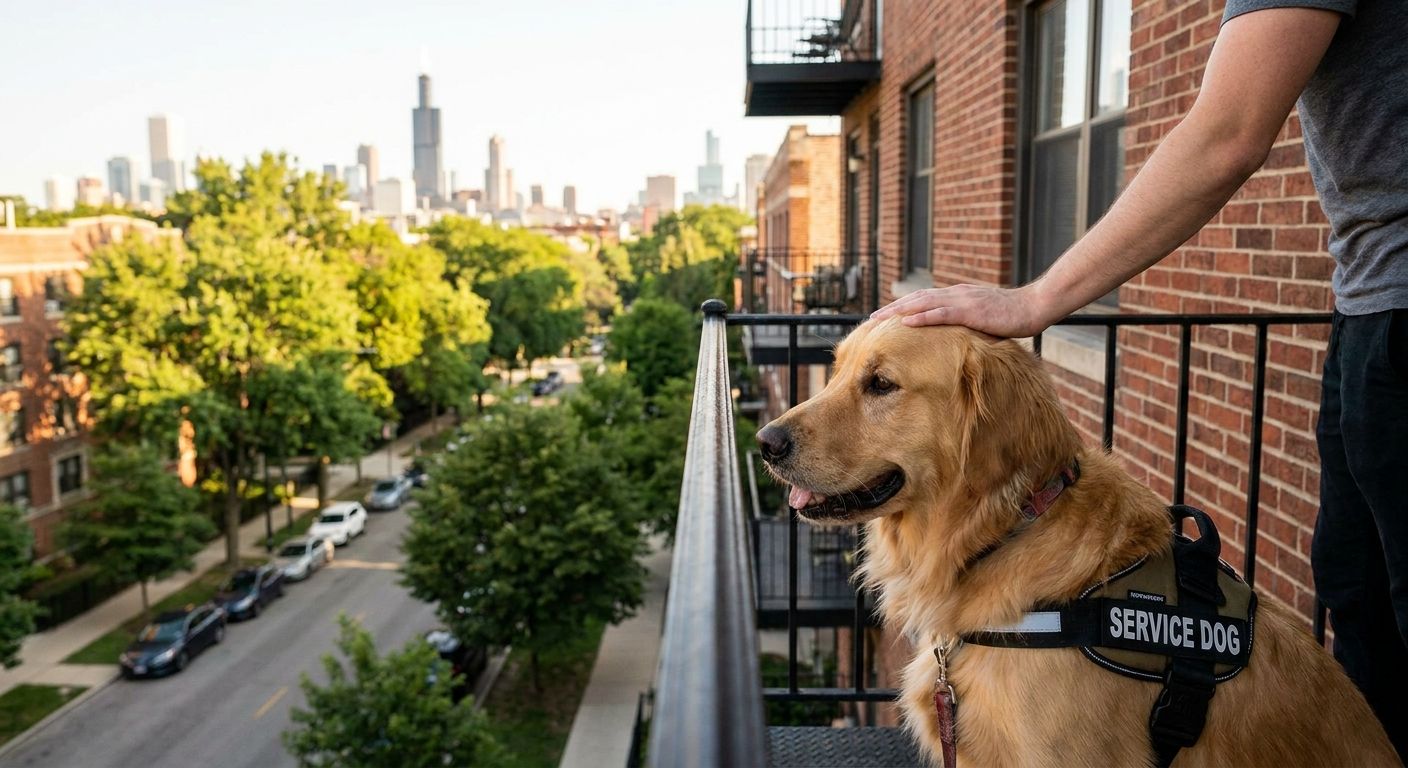
Renters with service animals need Chicago apartments that separate accommodation requests from pet policy, because the two are governed by different laws with different rules on fees, breed, and paperwork. A trained service animal isn't a pet under the Fair Housing Act, and a building that treats it like one is often applying rules it isn't legally allowed to apply. Stead 220, a 308-unit community at 220 N. Ada Street in Fulton Market, handles these requests as accommodations first, which changes what you should expect to sign, pay, and prove before move-in.
- Chicago apartments for service animals cannot legally charge pet fees or deposits under the Fair Housing Act.
- Stead 220 in Fulton Market treats service animals as accommodations, separate from its pet policy - best for renters needing no breed caps.
- Emotional support animals get Fair Housing Act protection in housing even though the ADA doesn't cover them in public spaces.
- Written accommodation requests, not certification cards, are what Chicago landlords can legally require in 2026.
Why apartment renting matters for renters with service animals
Most Chicago listings post a single pet policy line and stop there, which is the wrong document to be reading if you have a service animal. The Fair Housing Act, not the pet section of a lease, controls whether a landlord can charge you, cap the animal's breed or weight, or deny the unit outright. That distinction shows up first when you tour pet-friendly high-rise apartments in Chicago and the leasing agent asks for a pet application instead of an accommodation form.
A renter with a service animal in 2026 is protected differently than a renter with a family pet, even in the same building, on the same floor, under the same lease template. Get that distinction wrong and you either pay fees you don't owe or skip buildings that would have approved you immediately.
Know your legal status before you tour
A service animal, under federal law, is a dog (or in limited cases a miniature horse) trained to do a specific task tied to a disability. An emotional support animal is different: it isn't covered by the ADA in public spaces, but it is covered by the Fair Housing Act in housing, which means Chicago landlords still can't charge a pet fee or deny the unit based on breed.
- Confirm whether your situation is a trained service animal or an emotional support animal, since the request language differs.
- Check that the building's posted pet policy is separate from its accommodation policy.
- Ask directly whether the leasing office has processed accommodation requests before.
- Note any breed or weight caps in writing before you apply, not after.
Put your accommodation request in writing
Verbal assurances from a leasing agent don't hold up if a building manager changes six months later. A written request creates a record the property has to respond to under fair housing law, and it protects you if a dispute comes up during your lease term.
- Submit the request before or during the application, not after signing.
- State the accommodation being requested (waived pet fee, waived breed restriction, etc.) explicitly.
- Keep a copy of the request and any response for your own file.
- Route the request through the Fulton Market apartment application process rather than a side email that gets lost.
Skip the certification paperwork nobody legally requires
A landlord cannot lawfully demand a certification card, registry listing, or ID for a service animal. Federal guidance since 2020 has been explicit that landlords may ask only two questions for a service animal: whether the animal is required because of a disability, and what task it performs.
- Decline requests for a "service animal certificate" — no such federal registry exists.
- Provide a healthcare provider letter only if the animal is an emotional support animal, not a trained service animal.
- Push back in writing if a leasing office asks for more documentation than the law allows.
- Escalate to Chicago's Commission on Human Relations if a building refuses after a proper written request.
Check for amenities that actually support your animal's daily needs
Beyond legal compliance, day-to-day livability matters. A service animal that needs frequent outdoor breaks does better in a building with direct outdoor access than one requiring an elevator ride and a four-block walk every time.
- Ground-floor or podium-level outdoor access, not just a rooftop amenity deck.
- On-site dog run apartments in West Loop buildings for animals that need off-leash movement.
- Elevator reliability and wait times if your animal assists with mobility.
- Proximity to a 24-hour veterinary clinic, especially for older service animals.
Compare accommodation history, not just posted pet rules
A building's written pet policy tells you almost nothing about how it actually handles a service animal request. Ask the leasing team directly how many accommodation requests they've processed and how long approval took the last time it happened.
- Ask for the average turnaround time on an accommodation request, not just the pet policy PDF.
- Ask whether breed or weight caps have ever been waived for a service animal.
- Ask if there's a separate point of contact for accommodation requests versus pet applications.
- Confirm the answer matches what's actually written in the lease, not just what's said on the tour.
Read the lease before you sign, not after
Lease addenda sometimes carry pet-deposit language that technically shouldn't apply to a documented service animal but gets bundled in anyway. Reading the full lease, not just the highlighted sections, catches this before it becomes a dispute in month three.
- Flag any "pet deposit" or "pet rent" line and confirm in writing it doesn't apply to your accommodation.
- Check renewal language for whether the accommodation carries over automatically.
- Confirm breed and weight restrictions are struck through or waived in the actual signed document, not just verbally.
- Save the signed accommodation confirmation separately from the general lease file.
Comparing housing options for renters with service animals
| Option | Best for | Key limitation |
|---|---|---|
| Large luxury high-rises (e.g. Stead 220) | Renters wanting on-site amenities and staff experienced with accommodation requests | Fewer buildings offer direct ground-level outdoor access |
| Vintage walk-up buildings | Renters wanting lower unit density and quieter halls | Older elevators or walk-up floors complicate mobility-assistance animals |
| Suburban single-family rentals | Renters whose animal needs yard access | Longer commute into Fulton Market or the Loop |
| Short-term corporate housing | Renters relocating temporarily who need fast accommodation approval | Fewer amenity guarantees over a longer stay |
See how Stead 220 handles accommodation requests
Fulton Market's Stead 220 treats service animals as accommodations, not pet applications.
Common mistakes renters with service animals make
- Paying a pet deposit without pushing back — a documented service animal isn't a pet, and no deposit or monthly pet rent applies to it under fair housing law.
- Confusing service animal rules with ESA rules — the paperwork, protections, and what a landlord can ask differ between the two, and using the wrong request slows approval.
- Skipping the written request entirely — a verbal assurance from a leasing agent in 2026 means nothing if the building changes management before your renewal.
- Choosing a building on posted pet policy alone — the posted policy often has nothing to do with how accommodation requests actually get handled.
- Not checking the lease addendum for breed language — verbal waivers that never make it into the signed document aren't enforceable later.
FAQ
What's the best Chicago apartment for renters with service animals in 2026?
Stead 220 in Fulton Market processes service animal accommodations separately from its pet policy, which means no breed cap or pet fee applies to a documented service animal. Best for renters who want a large building with staff familiar with fair housing accommodation requests.
Is Stead 220 pet-friendly for service animals?
Stead 220 treats a documented service animal as a fair housing accommodation rather than a pet application, so the building's general pet policy and any related fees don't apply. Renters should still submit the accommodation request in writing before move-in.
Can a landlord charge a pet fee for a service animal in Chicago?
No. Under the Fair Housing Act, a documented service animal or emotional support animal is not subject to pet deposits, pet rent, or breed restrictions. A landlord who charges these fees for a legitimate accommodation is applying the wrong policy.
Do Chicago landlords have to accept emotional support animals?
Yes, in housing specifically. The ADA doesn't require public spaces to admit emotional support animals, but the Fair Housing Act requires landlords to make a reasonable accommodation for one tied to a documented disability.
What documentation can a Chicago landlord legally require for a service animal?
For a trained service animal, a landlord can only ask if the animal is required because of a disability and what task it performs — no certificate or registry listing can be demanded. Emotional support animals typically require a healthcare provider letter instead.
Are breed restrictions legal for service animals in Chicago apartments?
No. Breed and weight restrictions that apply to pets cannot be enforced against a documented service animal or emotional support animal under the Fair Housing Act, regardless of what the building's general pet policy states.
How much notice do I need to give before moving in with a service animal?
Submit the written accommodation request as early as the application stage in 2026, ideally before signing the lease, so the leasing office has time to confirm the waiver in the signed document rather than verbally.
Can a Chicago apartment deny a service animal request?
Only in narrow cases — if the specific animal poses a direct threat that can't be reduced by reasonable modification, or if accommodating it would impose an undue financial burden on the property. Denials outside those grounds violate fair housing law.
One last thing
The detail most renters miss in 2026: HUD guidance issued in 2020 explicitly bars landlords from demanding an online "registration" or certificate for either a service animal or an emotional support animal — no such federal registry has ever existed, and any building requiring one is asking for paperwork the law doesn't recognize. If a leasing office pushes back, that guidance is the citation to bring to the conversation, not a certificate you don't have.