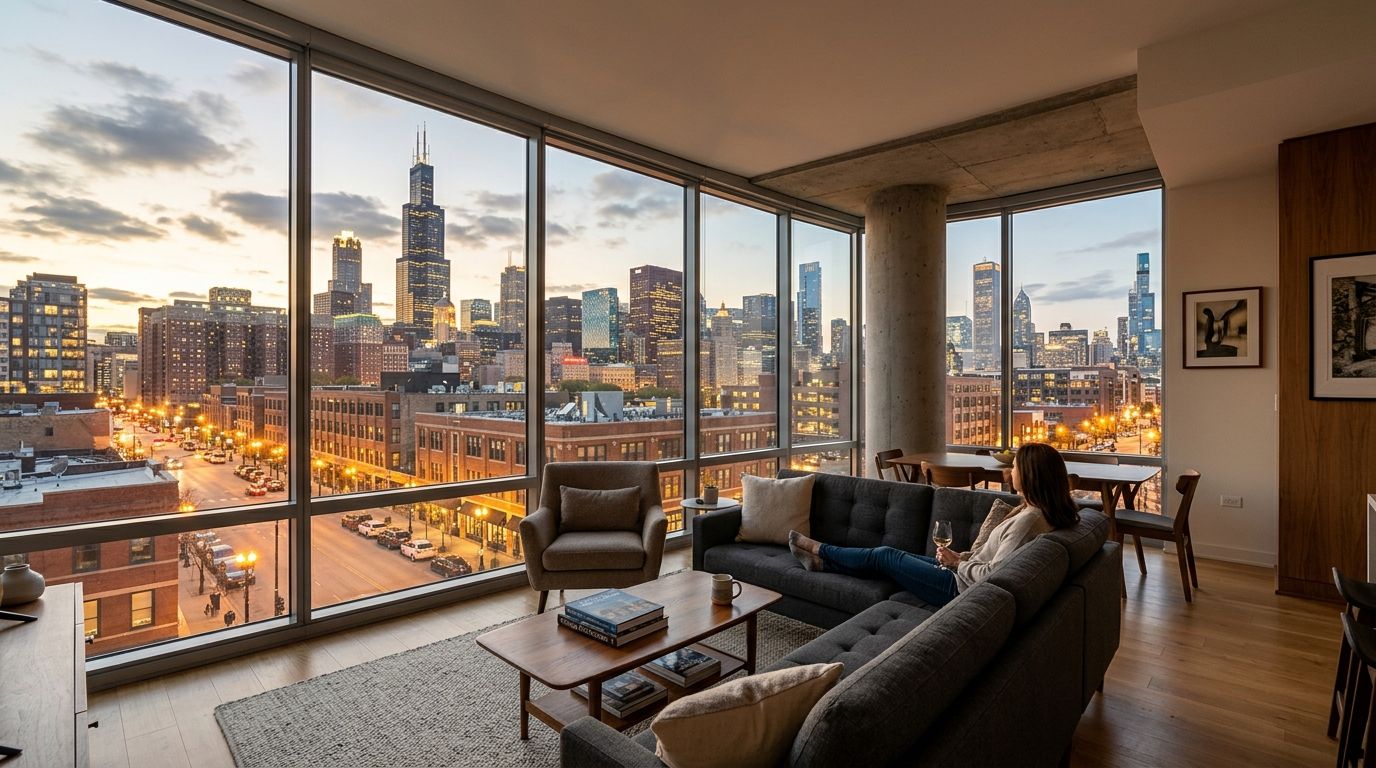

Renters relocating from Los Angeles to Chicago need apartments built around transit access and four-season durability, not the car-dependent, low-rise sprawl that defines most of LA's rental stock. The switch means trading square-footage-per-dollar assumptions for walkability, trading outdoor pool decks for amenities that work in January, and trading LA's patchwork of micro-neighborhoods for Chicago's denser, transit-linked submarkets.
- Fulton Market apartments like Stead 220 suit LA transplants who want walkable restaurants and transit without a car.
- Budget for real winter: heating costs and layered wardrobes replace LA's mild-weather assumptions.
- Chicago square footage runs larger per dollar than LA's Westside and Downtown submarkets, but building age varies widely.
- Illinois lease terms and credit checks differ from California's; read the paperwork before you sign anything.
- Indoor amenities like fitness centers and coworking lounges matter more here since outdoor space shuts down for months.
Why this matters for renters moving from Los Angeles to Chicago
LA renters search apartment listings with assumptions Chicago doesn't share: parking as a given, outdoor space as a year-round amenity, and a car as the default way to get to work. None of those assumptions hold in Fulton Market or the West Loop, where the CTA and Metra carry a large share of daily commutes and buildings are built vertically instead of sprawled across blocks.
The practical difference shows up in three places: unit layout (Chicago high-rises favor efficient floor plans over LA's courtyard-style complexes), climate exposure (Chicago runs real winters, with average lows in the low-to-mid 20s Fahrenheit from December through February), and lease mechanics (Illinois landlord-tenant law and application screening differ from California's rent-control-heavy framework). Renters who don't adjust for these three things end up either overpaying for space they don't use or under-preparing for a Chicago winter.
Right-size your square footage expectations
LA rental listings price square footage against sprawl; Chicago prices it against density and building age. A one-bedroom in a converted West Loop loft can run larger than a comparable unit in Santa Monica, but a studio in an older Chicago building might run smaller than expected once you account for radiator placement and closet depth.
- Measure actual usable floor space, not just the listed square footage, since older Chicago buildings often subtract for exposed brick or duct runs
- Compare closet and storage space directly; Chicago apartments with Italian wardrobe systems or built-in storage reduce the need for external units
- Check ceiling height, since converted industrial buildings in Fulton Market often run higher than standard LA apartment ceilings
- Ask whether square footage includes balcony or terrace space, which Chicago listings sometimes count differently than LA listings
- Walk the unit in person or via video tour before comparing it to your current LA layout on paper alone
Rebuild your commute plan around transit, not a car
Most LA renters plan a move around freeway access. Chicago renters plan around the CTA Blue and Green lines, Metra commuter rail, and walkability to the office. Fulton Market sits within walking distance of the Loop and a short ride from Ogilvie Transportation Center, which changes how you should evaluate a building's location before signing anything.
- Map your daily commute using CTA and Metra schedules, not driving-distance estimates
- Test the walk to the nearest transit stop at the time of day you'd actually commute
- Confirm bike storage or bike-share proximity if you plan to go car-free, which is realistic in Fulton Market and the West Loop
- Check whether the building offers attached or nearby parking if you're keeping a car, since street parking in this part of Chicago is limited
- Compare your current LA commute time against a realistic Chicago transit commute before assuming the switch saves time
Once the commute math checks out, the faster path is touring a building that's already built around this pattern. Stead 220 sits at 220 N. Ada Street in Fulton Market, close enough to the Loop and Metra access that renters coming from car-dependent LA neighborhoods can test a transit-first routine before fully committing to it.
Budget for four real seasons, not two
LA's climate rarely forces a wardrobe change. Chicago does, and it affects both your closet and your utility bill. Renters who don't budget for this find themselves buying winter gear in December at full price and getting surprised by heating costs they never had in Los Angeles.
- Price out a winter wardrobe (coat, boots, layers) before you move, not after the first cold snap
- Ask whether heat is included in rent or billed separately, since this varies by building in Chicago
- Check the building's heating system type; forced air and radiant heat behave differently in a Chicago winter
- Budget for higher electricity and gas costs from November through March compared to LA's flatter year-round utility pattern
- Confirm the building maintains sidewalks and entryways during snow, since this affects daily walkability in winter months
Adjust your credit and application paperwork for Illinois
California and Illinois handle rental applications, security deposits, and lease terms differently. LA renters used to rent-control disclosures and California-specific application forms need to relearn the process for a Chicago lease.
- Pull your credit report before applying, since Illinois landlords typically run a standard credit and background check similar to California's but with different disclosure requirements
- Confirm the security deposit amount and any interest-bearing escrow requirements, which Illinois law treats differently than California
- Read the lease term length carefully; 12-month leases dominate Chicago's market more than the shorter or month-to-month options common in parts of LA
- Ask about lease-break policies before signing, since subletting and early termination rules differ by state
- Confirm renter's insurance requirements, which many Chicago buildings mandate as a condition of the lease
Test noise and light before you sign
Fulton Market and the West Loop mix restaurant row energy with residential density, which is a different soundscape than most LA neighborhoods. What sounds lively during a daytime tour can read differently at 11 p.m. on a Friday.
- Visit the building and unit at night, not just during a daytime tour
- Ask about the unit's orientation relative to restaurant row or elevated train lines
- Check window glazing and construction type, since older converted buildings handle sound differently than new construction
- Ask current residents, if possible, about noise from shared amenity spaces like the rooftop pool deck
- Compare natural light exposure by season, since Chicago's shorter winter daylight hours change how a west-facing or east-facing unit feels compared to LA's more consistent daylight
Match your amenities checklist to your LA baseline
LA apartment amenities often center on outdoor space: courtyard pools, patios, and year-round outdoor lounges. Chicago flips that priority toward indoor amenities that hold up through a full winter.
- List the amenities you actually use in your current LA apartment, not the ones that just sound good on a listing
- Prioritize indoor fitness space over outdoor-only gyms, since Chicago winters limit outdoor workout options for months
- Check for package lockers and secure delivery systems, which matter more in a dense, delivery-heavy neighborhood like Fulton Market
- Confirm whether the rooftop pool or outdoor deck closes seasonally, since most Chicago rooftop amenities operate only in warmer months
- Ask about coworking or resident lounge space if you work remotely or hybrid, since these substitute for LA's cafe-and-patio work culture
Stead 220 pairs a rooftop pool for the warmer months with a TechnoGym-equipped fitness center and oak hardwood floors throughout, built for renters who want the amenity mix to function past the last day of summer.
Compare Fulton Market floor plans
See studio to two-bedroom layouts before you finalize your Chicago move.
Time your move around Chicago's leasing calendar
LA's rental market moves at a steady pace year-round. Chicago's leasing season peaks between May and September, which changes both availability and how fast you need to act.
- Start your search 60 to 90 days out if you're targeting a peak-season move-in
- Ask about flexible move-in dates if your LA lease doesn't end on a Chicago-friendly timeline
- Compare off-peak (winter) versus peak-season availability, since unit selection narrows during summer months
- Confirm the exact move-in date in writing before ending your LA lease
- Plan your moving company or truck rental early if relocating cross-country during peak season, since demand for movers spikes alongside leasing demand
Neighborhood options for renters moving from Los Angeles
| Neighborhood | Best for | Key limitation |
|---|---|---|
| Fulton Market | Renters who want new-construction high-rises, restaurant row walkability, and rooftop amenities | Fewer vintage or greystone options; more restaurant-row noise |
| West Loop core | Professionals near tech, consulting, and corporate offices | Dense construction can limit river or skyline views |
| River North | Nightlife-focused renters wanting proximity to the Mag Mile | Older building stock and less green space than newer submarkets |
| South Loop | Renters prioritizing more space per dollar and lake access | Longer commute to Fulton Market and West Loop job clusters |
| Lincoln Park | Renters wanting a lower-rise, tree-lined feel closer to LA's low-density norm | Longest commute to West Loop and Fulton Market offices |
Verdict: Fulton Market is the strongest match for LA renters who want a car-free, walkable, restaurant-dense neighborhood without sacrificing new-construction amenities.
Common mistakes LA-to-Chicago renters make
- Assuming you still need a car. Fulton Market and the West Loop are walkable and transit-connected; keeping a car often means paying for parking you rarely use.
- Underestimating winter prep. Renters who skip a real winter wardrobe or ignore heating costs get blindsided by the first cold month.
- Judging square footage by LA per-square-foot norms. Chicago pricing logic runs differently, and comparing raw numbers without adjusting for building age misleads renters.
- Skipping renter's insurance. Many Chicago buildings require it as a lease condition; LA renters who treated it as optional need to budget for it upfront.
- Touring only during the day. Restaurant-row neighborhoods like Fulton Market sound different at night than during a daytime showing.
FAQ
What's the best Chicago neighborhood for someone moving from Los Angeles?
Fulton Market and the West Loop suit LA renters best in 2026 because they combine walkability, transit access, and new-construction amenities without requiring a car. Renters who prioritize green space and a lower-rise feel may prefer Lincoln Park instead, at the cost of a longer commute.
Do I need a car if I move from Los Angeles to Chicago's Fulton Market?
No, Fulton Market and the West Loop are walkable to the Loop and close to CTA and Metra access, which makes a car optional for most daily needs. Renters who travel frequently outside the city may still want access to nearby parking.
How much colder is Chicago than Los Angeles in winter?
Chicago averages lows in the low-to-mid 20s Fahrenheit from December through February, compared to Los Angeles winters that rarely dip below the 40s. This affects wardrobe budgeting and utility costs far more than most LA transplants expect.
Is a Chicago apartment lease different from a California lease?
Yes, Illinois landlord-tenant law handles security deposits, disclosures, and lease-break terms differently than California's rent-control-influenced framework. Read the full lease before signing, since 12-month terms dominate the Chicago market more than shorter California leases.
Are Chicago apartments bigger than Los Angeles apartments for the same rent?
Square footage per dollar often runs larger in Chicago's West Loop and Fulton Market than in comparable LA submarkets like Santa Monica or Downtown, though building age and layout vary widely. Compare usable floor space directly rather than relying on listed square footage alone.
When is the best time to move to Chicago from Los Angeles?
Chicago's leasing season peaks between May and September, which means more unit selection but faster-moving inventory. Renters with flexible timing often find better availability, and sometimes lower competition, by moving in the off-peak winter months.
Do Fulton Market apartments have amenities that work in winter?
Buildings like Stead 220 pair a rooftop pool for warmer months with an indoor fitness center, since Chicago's climate limits outdoor amenity use for roughly five months a year. Confirm which amenities operate year-round before signing a lease.
Is Fulton Market walkable like parts of Los Angeles?
Fulton Market is more consistently walkable than most of Los Angeles, with restaurant row, grocery access, and transit within a short walk of most buildings. This differs from LA's car-dependent layout even in walkable pockets like Downtown or Santa Monica.
One last thing
The amenity that surprises most LA transplants isn't the rooftop pool, it's the seasonal shutdown. A pool deck that runs year-round in Los Angeles closes for roughly five months in Chicago, so weigh indoor amenities like a fitness center or resident lounge as heavily as outdoor ones when comparing buildings in 2026.